Africa's Top Growth Markets for 2027: Where Investors Are Looking Now
The IMF expects sub-Saharan Africa to grow faster than the global average into 2027. Here are the markets leading the pack, what is driving them, and the risks investors should weigh.
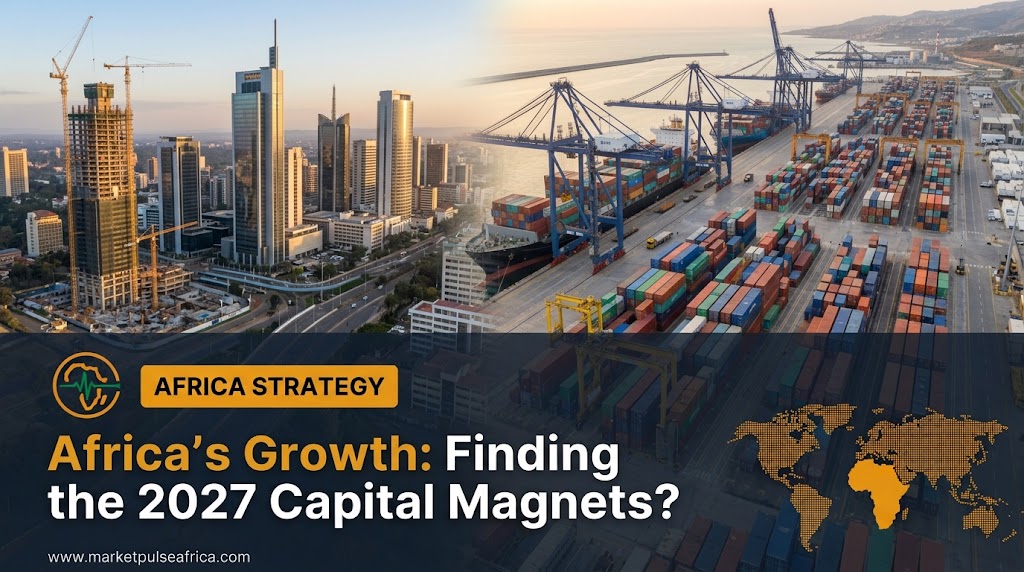
Sub-Saharan Africa is on track to grow faster than the global economy into 2027, and a handful of markets are pulling well ahead of the rest. The International Monetary Fund projects the region's growth at 4.6 percent in 2027, compared with a global rate of 3.2 percent. Ethiopia, Uganda and Rwanda are forecast to post growth above 7 percent in 2026, while South Africa, one of the continent's largest economies, is expected to manage only about 1.5 percent in 2027. That gap is the story for investors. The continent's average growth looks strong, but the returns will depend on which countries are growing, how fast, and whether their policies hold up. This article looks at the markets leading the pack, what is driving them, and the risks that could change the outlook. You will leave with a clearer view of where growth is concentrated and what to verify before committing capital.
Contents
- Why 2027 is a turning point for African growth
- The markets leading the pack
- Strengths and weak points, market by market
- Risks that could erase the growth story
- What investors should check before committing capital
- Related Reading
Why 2027 is a turning point for African growth
Africa's growth outlook has stayed resilient even as global forecasts were cut. In its April 2026 World Economic Outlook, the IMF kept several African economies among the world's fastest-growing, despite a wave of downward revisions caused by conflict in the Middle East and wider geopolitical uncertainty. Eleven of the world's fifteen fastest-growing economies are expected to be African, according to figures cited by BusinessDay.
The broader regional picture also improved. The IMF raised its sub-Saharan growth forecast in January, now expecting the region to expand 4.6 percent in 2026 and again in 2027, after 4.4 percent growth in 2025. The fund credited macroeconomic stabilization and reform efforts in major economies for the lift. For investors, the important part is the direction. Growth is not just holding steady; it is expected to accelerate slightly and stay above the global average.
There is a longer-term argument as well. Africa's population is young and growing, and its working-age population is expected to outpace those of China and India combined by 2050. Growth that is driven by a large, expanding workforce tends to attract sustained investment in consumer markets, infrastructure and services. That is why the 2027 outlook matters beyond any single year's numbers.
The markets leading the pack
The IMF's April 2026 ranking of fast-growing African economies is led by Ethiopia, Guinea, Uganda, Rwanda, Benin and Côte d'Ivoire. Ethiopia stands out as the continent's strongest performer, with real GDP growth forecast at 9.2 percent for 2026. That would make it the world's second-fastest-growing economy after Guyana. Uganda is forecast to expand 7.5 percent and Rwanda 7.2 percent, which keeps East Africa among the most dynamic growth regions in the world.
West Africa is also well represented. Côte d'Ivoire appears in the IMF's leading group, and Niger is forecast to grow about 6.7 percent in 2026, a slight slowdown from 6.9 percent in 2025. Libya's growth is tied largely to hydrocarbons, with output improving on the back of higher oil production. Nigeria, Africa's third-largest economy by GDP according to IMF projections, sits just outside the top ten at 4.1 percent growth. For investors tracking Nigeria specifically, the IMF's assessment is more encouraging than the headline number suggests: it said the government's recent exchange rate adjustments and efforts to raise non-oil revenue could strengthen investor confidence, provided those policies are sustained.
Egypt, North Africa's largest economy, is a different case. The IMF raised its forecast for Egypt's real GDP growth in the 2025/2026 fiscal year to 4.7 percent, up from 4.5 percent. That is a steadier, lower-volatility profile than the frontier growth stories in East Africa, and it appeals to investors who want scale with less exposure to swings in commodity prices. Our earlier coverage of Egypt's fuel export profile shows how much its external earnings still depend on energy.
Strengths and weak points, market by market
Headline growth rates only tell part of the story. Each market in the top tier has a different mix of advantages and constraints, and those mixes matter for the kind of capital each one can absorb.
- Ethiopia (9.2 percent, 2026): The strongest growth rate on the continent, but the forecast assumes continued stability. Investors should separate the growth figure from the currency, debt and policy questions that come with it.
- Uganda (7.5 percent, 2026): Growth is supported by investment in infrastructure, manufacturing, agriculture and services, which gives it a broader base than many resource-led economies.
- Rwanda (7.2 percent, 2026): A smaller market with strong growth and a reputation for policy discipline, though its size limits the total pool of capital that can be deployed.
- Côte d'Ivoire: A leading growth performer in West Africa's francophone bloc, with a regional currency arrangement that many investors view as a stabilizing factor. Our coverage of Côte d'Ivoire's foreign direct investment inflows in 2025 is a useful companion read.
- Nigeria (4.1 percent, 2026): Large market, large population and deep corporate base, but growth is modest for its size and currency volatility remains a real cost for foreign investors.
- South Africa (1.5 percent, 2027): Deep capital markets and a sophisticated financial sector, held back by long-standing structural bottlenecks that keep growth low.
The contrast is clearest between high-growth frontier markets and large, slower economies. A frontier market can offer faster expansion from a smaller base, but it usually carries thinner liquidity and higher policy risk. A larger market offers deeper markets and more exit options, but its growth is often slower. Neither is automatically better. The right choice depends on how much volatility an investor can absorb and how long they plan to hold.
Risks that could erase the growth story
The IMF has been clear that growth does not remove vulnerabilities. Its commentary points to overlapping monetary, financial, external and fiscal pressures across many African economies. Those pressures show up in several ways.
Debt service is the largest near-term burden. Reports based on IMF data indicate that African countries face repayments of close to $95 billion in 2026, and some governments are expected to spend as much as a fifth of their budgets servicing external debt. When a large share of revenue goes to creditors, less is available for the infrastructure and services that support growth.
Conflict and supply shocks can reverse growth quickly. South Sudan offers the clearest example. Its forecast was once above 22 percent, one of the highest in the world, but the IMF has cut it to 4.1 percent as disruption to oil exports and spillover from the conflict in Sudan weigh on activity. Resource-dependent economies are especially exposed to this kind of reversal.
Climate and political risk are harder to price. Extreme weather, political instability and the strain of rapid urbanization can all disrupt forecasts that look solid on paper. Investors should treat these as baseline risks, not edge cases.
What investors should check before committing capital
A growth forecast is a starting point, not a decision. Before committing capital to any of these markets, a few checks can separate durable opportunities from headline-driven ones.
Check the currency first. Strong real growth can be wiped out by currency depreciation when returns are converted back to dollars or euros. Look at how the exchange rate has moved over the past two years and whether the central bank is intervening or allowing the currency to adjust.
Check whether policy changes are being sustained. The IMF's comments on Nigeria are a good example. Reforms that raise revenue or stabilize the exchange rate only help investors if they hold through the next election cycle and the next budget. A single policy announcement is not the same as a durable change.
Check the sector, not just the country. Growth in construction, telecoms, fintech and manufacturing does not carry the same risks as growth tied to oil or mining prices. Commodity-linked growth can look strong until prices turn, so it helps to know how much of a market's expansion depends on a single export.
Check the exit. Frontier markets often have thin trading volumes and limited depth in local capital markets. An investment that is easy to enter can be hard to leave. Before buying, confirm how a position would be sold if conditions change.
Related Reading
For more on how these trends are showing up in the data, read our full coverage of Kenya's ores and metals exports, which shows how the mix of exports is shifting across the region. You can also revisit our analysis of Côte d'Ivoire's foreign direct investment for a closer look at one of the leading West African growth stories, and read our full coverage of Ghana's food exports to see how agriculture is contributing to the wider picture.
Which of these markets would you put at the top of your watchlist for 2027? Tell us in the comments, and keep following MarketPulse Africa for the latest data, analysis and signals on African markets.