
African Central Banks Hold the Line as Inflation Shapes Rate Decisions
Nigeria, South Africa and Kenya kept their benchmark interest rates unchanged as policymakers balanced inflation risks against economic growth. The decisions highlight the different pressures facing three of Africa's largest economies.
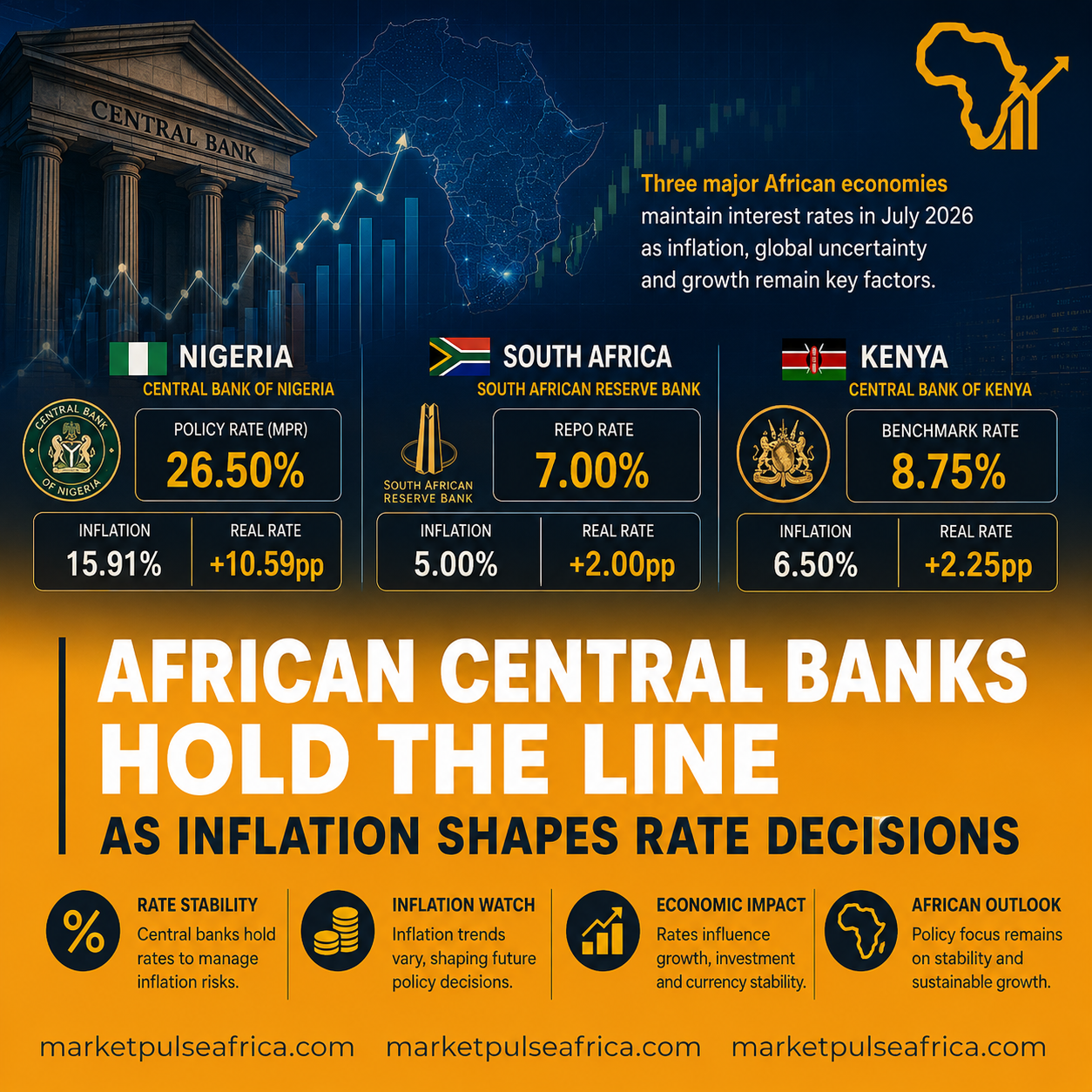
African Central Banks Hold the Line as Inflation Shapes Rate Decisions
Executive Summary
Three major African economies maintained their benchmark interest rates in July 2026 as policymakers continued to assess inflation, global uncertainty and economic growth.
Nigeria held its MPR at 26.50%, South Africa kept its repo rate at 7.00%, while Kenya's benchmark rate remained at 8.75%.
Nigeria Keeps Rates at 26.50%
The Central Bank of Nigeria maintained its Monetary Policy Rate at 26.50% on July 21.
Inflation eased slightly to 15.91%, marking an extended period of disinflation.
However, food inflation remained elevated at 17.52%, keeping pressure on policymakers.
South Africa Holds at 7%
The SARB maintained its repo rate at 7.00% following a 4-2 vote.
South African inflation reached 5.00%, a two-year high.
The SARB nevertheless revised its 2026 inflation forecast down to 4.00%.
Kenya Maintains 8.75%
Kenya's benchmark rate remained at 8.75%.
Inflation rose to 6.50% in July, remaining within the CBK's target range but above its 5% midpoint.
Market Data
Country | Policy Rate | Inflation | Real Rate |
|---|---|---|---|
Nigeria | 26.50% | 15.91% | +10.59pp |
South Africa | 7.00% | 5.00% | +2.00pp |
Kenya | 8.75% | 6.50% | +2.25pp |
Why It Matters
Interest-rate decisions influence borrowing costs, investment flows, currency stability and consumer spending.
For African businesses, understanding central-bank policy is increasingly important for managing financing costs and expansion plans.