AI could disrupt 40% of global jobs – IMF warns
The IMF says almost 40 percent of jobs worldwide are exposed to AI. Here is what that exposure means, why it varies by income level, and what it could mean for Africa.
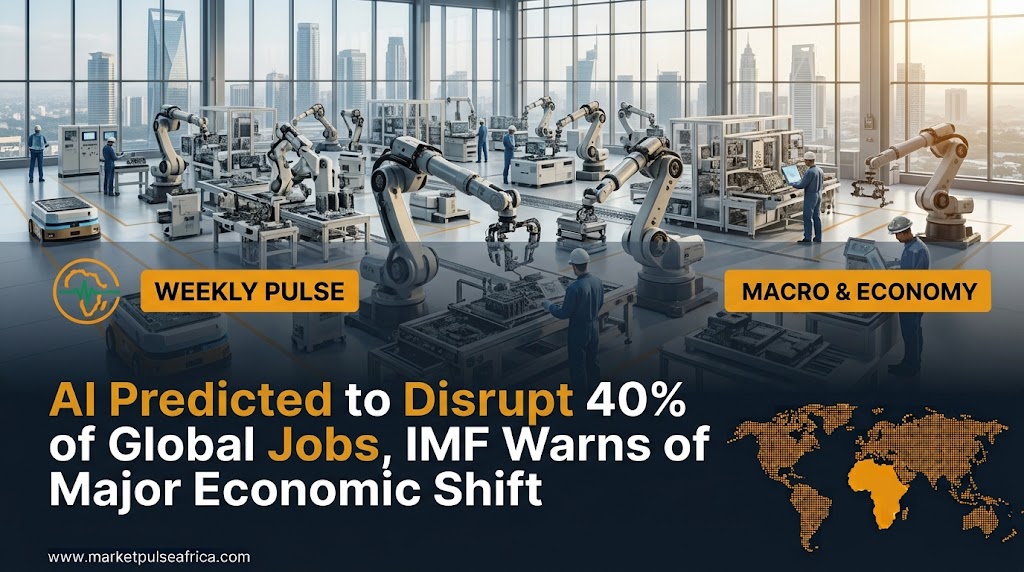
The International Monetary Fund estimates that almost 40 percent of jobs worldwide are exposed to artificial intelligence, with about 60 percent of jobs in advanced economies, 40 percent in emerging markets and 26 percent in low-income countries affected. Exposure does not mean every affected job disappears. The IMF's analysis says roughly half of exposed jobs may benefit from AI through higher productivity, while the rest could see key tasks taken over by machines, leading to lower labor demand, reduced hiring and lower wages. In the most extreme cases, some jobs may disappear. The findings come from an IMF analysis first published in January 2024 and promoted in a blog post by Managing Director Kristalina Georgieva, so they describe risk rather than measured job losses. For Africa, the picture is mixed: lower exposure on paper, but a smaller margin for benefiting from the technology. This article explains what the IMF is saying, what it means for workers and policymakers, and what African markets should take from it.
Contents
- What the IMF found
- Exposure is not the same as job loss
- Why advanced economies are more exposed
- What it means for Africa
- The inequality risk inside countries
- What to watch next
- Related Reading
What the IMF found
The IMF's analysis looked at how AI could affect the global labor market. Its headline finding is that nearly 40 percent of jobs worldwide are exposed. The figure varies sharply by income level. In advanced economies, about 60 percent of jobs may be affected. In emerging markets, the estimate falls to about 40 percent, and in low-income countries it is 26 percent. NBC News reported that high-income economies therefore face greater risks than emerging markets and low-income countries.
The IMF's framing also differs from older waves of automation. Historically, machines and information technology have mostly affected routine tasks. AI is different because it can affect high-skilled work, including analysis, writing and professional services. That is why exposure is concentrated in advanced economies, where many jobs involve white-collar tasks.
Exposure is not the same as job loss
The headline number can be misread. The IMF's point is that about 40 percent of jobs will be affected, not that 40 percent will be lost. The analysis suggests roughly half of the exposed jobs may benefit from AI, because workers who use the technology well can become more productive. The other half face a different outcome. AI systems may perform tasks currently done by people, which could reduce demand for labor, slow hiring and pull down wages.
Georgieva put it plainly: some jobs may be enhanced, while others may disappear altogether. Which group a worker falls into depends on the role, the skills they have, and whether employers and governments help them adapt. The IMF has called for social safety nets and retraining programs for workers who are most at risk.
Why advanced economies are more exposed
The reason advanced economies sit at the top of the exposure list is their job mix. Economies with large service sectors, financial industries and professional occupations have more roles that AI tools can already assist with. Economies built more around agriculture, informal trade or manual labor have fewer such roles, at least for now. That lower exposure is not automatically good news. It can also mean fewer of the productivity gains that AI brings to workers and firms.
This is the IMF's main warning for emerging and low-income economies. Their lower exposure could lead to slower adoption and a larger gap in the benefits. Many countries lack the infrastructure, electricity, digital access and skilled workforce needed to make AI useful, and the IMF has flagged the risk that over time the technology could widen inequality between nations.
What it means for Africa
For African economies, the IMF analysis points in two directions at once. On the one hand, many countries have lower exposure than advanced economies because their labor markets rely less on high-skilled office work. On the other, that lower exposure does not mean they will automatically benefit. The gains from AI depend on digital infrastructure, power supply, education and the ability of firms to adopt new tools.
The stakes are high because Africa's labor force is growing quickly. The continent's working-age population is expected to exceed that of China and India combined by 2050. If AI boosts productivity in sectors such as fintech, logistics, agriculture and services, it could help young workers find better-paid jobs. If the technology arrives faster than digital skills and infrastructure, the benefits could go to a small group of firms and workers, while others are left behind.
For investors, the practical question is where AI adoption will create value. Companies that combine local market knowledge with digital tools may have an advantage, while those that depend on routine tasks that automation can replace may face pressure. Policymakers, meanwhile, have a window to invest in skills and connectivity before adoption accelerates.
The inequality risk inside countries
The IMF also warns that AI could widen income and wealth gaps within countries. In most scenarios, the analysis suggests AI will likely worsen overall inequality unless governments act. Georgieva described the risk of "polarization within income brackets", where workers who can use AI see productivity and wages rise, while those who cannot fall behind. That pattern is familiar from earlier waves of technology, but the IMF argues AI could move faster and reach higher-skilled jobs.
The policy response the IMF recommends is a mix of education, social protection and regulation. The fund has argued that advanced economies should pursue AI innovation and adoption while building strong regulatory frameworks. For countries with less capacity, the emphasis is on closing infrastructure and skills gaps before the technology spreads.
What to watch next
Three things will show whether the IMF's warning becomes reality. The first is whether AI adoption actually changes hiring and wage patterns, rather than just productivity measures in specific firms. The second is how quickly African countries close gaps in electricity, broadband and digital skills. The third is whether governments and employers invest in retraining in time for workers to move into new roles.
Investors and business leaders should also watch which sectors adopt AI fastest, because that will shape where jobs are created or lost. Data from the labor market, company announcements and public training programs will give a clearer picture than any single forecast.
Related Reading
For more on the economic backdrop, read our full coverage of Côte d'Ivoire's foreign direct investment inflows in 2025, which shows how capital is moving into one of West Africa's growing economies. You can also read our coverage of Kenya's ores and metals exports, which shows how export structures shape the jobs an economy creates.
How do you think AI will change work in your sector? Share your view in the comments, and keep following MarketPulse Africa for analysis on jobs, markets and policy across the continent.