
Attijariwafa Bank to acquire majority stake in Société Générale Ghana
Attijariwafa Bank has agreed to take a 55.22% majority stake in Société Générale Ghana, while SSNIT increases its holding, marking Société Générale’s exit from the subsidiary.
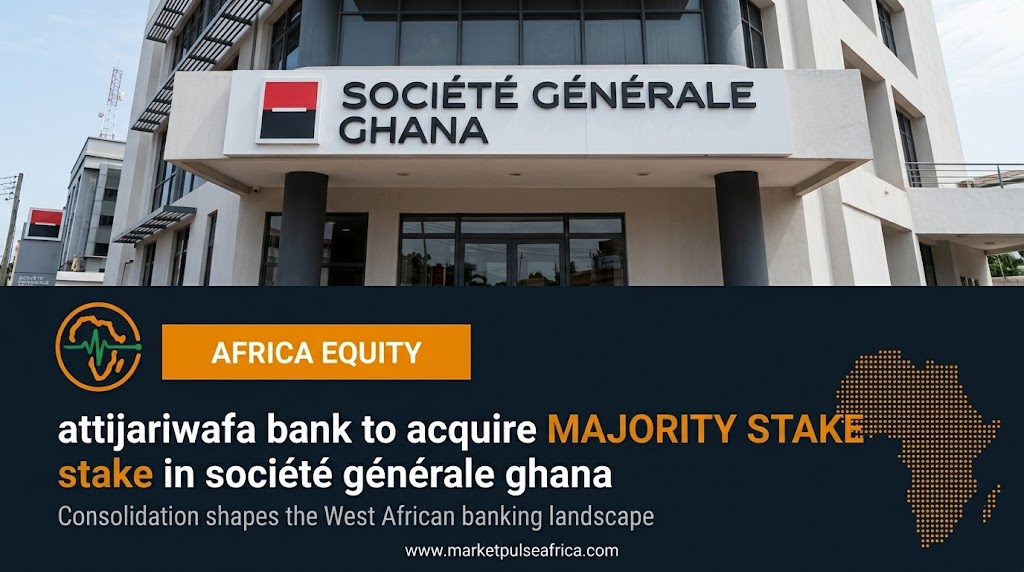
Attijariwafa Bank to Acquire Majority Stake in Société Générale Ghana
Morocco’s Attijariwafa Bank has signed an agreement to acquire a majority stake in Société Générale Ghana as the French banking group exits its Ghanaian subsidiary. Under the deal announced on 1 October 2026, Attijariwafa Bank will take a 55.22 percent shareholding while Ghana’s Social Security and National Insurance Trust (SSNIT) will acquire an additional 5 percent, taking its total holding to 24.36 percent.
Société Générale Group is divesting its entire 60.22 percent stake in the Ghanaian bank. Once completed, Attijariwafa will assume control of all operations, client portfolios and employees of Société Générale Ghana. The transaction remains subject to the usual conditions precedent and approvals from the relevant financial and regulatory authorities in Ghana and Morocco.
Key Terms of the Transaction
Attijariwafa Bank: 55.22 percent (majority stake)
SSNIT: additional 5 percent (raising its holding from 19.36 percent to 24.36 percent)
Société Générale Group: full exit from its 60.22 percent position
Other existing shareholders, including Ghanaian businessman Daniel Ofori (approximately 6.81 percent), are expected to retain their stakes
Société Générale Ghana operates around 40 branches across the country and employs more than 500 people. At the end of 2025 the bank reported total assets of about GHS 9.7 billion, shareholders’ equity of GHS 2.6 billion, net banking income of GHS 1.36 billion and net profit of GHS 397 million. Its market capitalisation stood near GHS 3.9 billion in late September 2026.
Strategic Context for Attijariwafa and Société Générale
For Attijariwafa Bank, one of North Africa’s largest banking groups, the acquisition adds Ghana to its growing West African footprint, which already includes operations in Senegal, Côte d’Ivoire, Mali and Togo. The group has been expanding across the continent as part of a broader pan-African strategy.
For Société Générale the sale continues a wider review of its African presence. The French group has been streamlining its international portfolio in recent years. The Ghana exit follows a strategic review of the subsidiary that began more than two years earlier.
SSNIT has described the increased stake as strengthening Ghanaian ownership in a major commercial bank and supporting long-term value for pension contributors.
Implications for Ghanaian and African Banking Markets
The change of control is significant for Ghana’s banking sector. A large, well-capitalised Moroccan group takes over a established mid-sized commercial bank, while local institutional ownership via SSNIT rises. Customers and staff are expected to continue under the existing operational structure pending regulatory clearance and integration planning.
Across West Africa the deal illustrates two parallel trends: European banks selectively reducing direct ownership of certain African subsidiaries, and North African financial institutions expanding southward. Similar ownership shifts have been observed in other markets as capital and strategy realign.
Investors and counterparties will watch regulatory timelines, the eventual rebranding or integration process, capital ratios, and any changes in lending or product strategy once Attijariwafa assumes control. Readers tracking African banking consolidations, cross-border investments and Ghanaian financial-sector developments can follow related coverage on MarketPulse Africa and its blog.
What Market Participants Should Monitor
Progress of regulatory approvals by the Bank of Ghana and Moroccan authorities
Completion timeline and any conditions attached
Post-deal capital structure, management appointments and strategic direction under Attijariwafa
Impact on Société Générale Ghana’s customer base, deposit franchise and loan book
Broader West African banking consolidation activity
These are observational points only and do not constitute investment advice.
Practical Takeaways
For banking and financial professionals
Ownership transitions of this scale can affect correspondent relationships, product offerings and risk frameworks over time.
Local institutional investors such as SSNIT gain greater influence in a key listed bank.
For investors and analysts
Monitor official disclosures on the Ghana Stock Exchange and regulatory filings for completion updates.
Track how the new majority shareholder’s capital strength and regional network may influence the bank’s competitive position.
How MarketPulse Africa Helps
MarketPulse Africa delivers real-time intelligence on African markets, covering equities, banking and financial-sector developments, cross-border investment, currencies and macroeconomic trends. For readers following ownership changes, regional banking expansion and Ghanaian capital-market activity, the platform brings the relevant news and context together.
Conclusion
Attijariwafa Bank’s agreement to acquire a 55.22 percent majority stake in Société Générale Ghana, alongside SSNIT’s increased holding, marks a clear ownership transition in one of Ghana’s established commercial banks. Société Générale’s full exit and the entry of a major North African banking group reflect ongoing shifts in African financial-sector ownership.
Completion remains subject to regulatory approvals. Once finalised, the deal will reshape the shareholder structure of Société Générale Ghana and add another West African market to Attijariwafa’s pan-African network.
Follow MarketPulse Africa for continued coverage of African banking deals, equity developments and real-time market intelligence.