J.P. Morgan Merchant Bank in Nigeria Moves Closer After N50bn CBN Deposit
J.P. Morgan's merchant bank in Nigeria is a step closer: the US lender has deposited N50bn with the CBN, meeting the licence capital floor. What it could do.
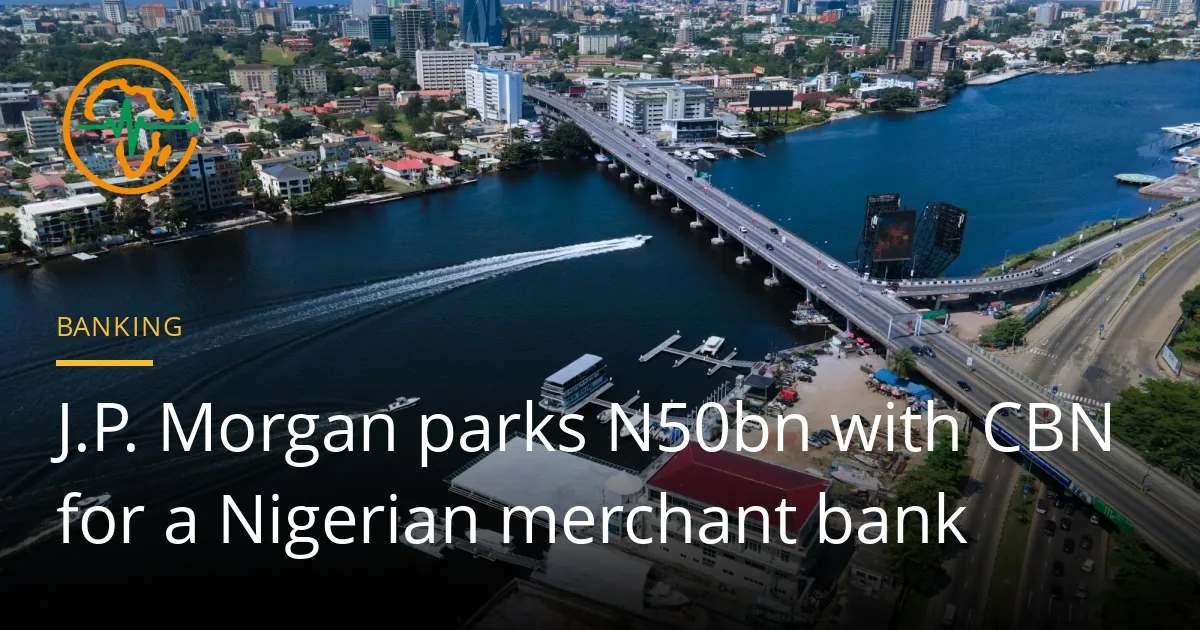
J.P. Morgan's plan for a merchant bank in Nigeria has moved from announcement to paperwork. The US lender has deposited N50 billion, about $38 million, with the Central Bank of Nigeria (CBN), according to a Bloomberg report cited by BusinessDay on 21 October 2026. The deposit meets the minimum capital the CBN sets for a merchant banking licence, though it does not guarantee approval.
If the licence comes through, the Wall Street bank would run its first licensed banking operation in Nigeria after decades of working mainly through a representative office in Lagos. Bloomberg reported that J.P. Morgan expects the licence by the end of 2026 or early in 2027, subject to the regulator's decision. J.P. Morgan declined to comment to BusinessDay, and the CBN did not immediately respond.
What the J.P. Morgan merchant bank in Nigeria could do
A merchant banking licence in Nigeria is narrower than a commercial one. Merchant banks do not take retail deposits from the public. They serve companies, governments and institutions. According to BusinessDay's reporting, a licence would let J.P. Morgan move beyond advisory work into:
- corporate lending to large Nigerian and multinational companies
- treasury and foreign exchange services
- capital markets transactions, including bond and equity deals
- asset management, depending on the scope of approval
The choice of licence matters. Under the CBN's recapitalisation framework, which ran from April 2024 to a 31 March 2026 deadline, a merchant bank needs at least N50 billion in paid-up capital. A commercial bank with a national licence needs N200 billion, and one with an international licence needs N500 billion, according to the thresholds published by the CBN and reported by Peoples Gazette in February 2026. The N50 billion deposit fits the merchant tier exactly, which points to a wholesale business rather than a high-street bank.
From a Singapore announcement to a CBN deposit
The timeline has been short. On 8 October 2026, Dapo Olagunji, managing director of J.P. Morgan West Africa, announced the plan at the Nigeria–Asia Financial Connectivity Dialogue in Singapore, according to Daba Finance. The CBN convened that event with J.P. Morgan, Nigerian Exchange Group and FMDQ Group, ahead of the IMF–World Bank Annual Meetings.
Speaking at the same event, CBN Governor Olayemi Cardoso said foreign exchange reforms aimed to remove distortions and build market confidence, and that long-term capital needed "credible monetary policy, stronger governance, improved market functioning, and predictable rules." Less than two weeks later, the capital deposit is in place.
Reports of J.P. Morgan's interest go back further. In April 2025, reports said the bank was preparing to turn its Lagos representative office into a fuller business and apply for a merchant banking licence.
Why a global bank wants a Nigerian licence now
J.P. Morgan is not new to Nigerian finance. It has advised the federal government and Nigerian companies on Eurobond issues and other transactions for years. Its bond indices also shape foreign portfolio flows. Nigeria joined the J.P. Morgan Government Bond Index-Emerging Markets in October 2012 and was removed in 2015 over concerns about access to foreign exchange and liquidity.
The market backdrop has changed since then. The naira closed at N1,331.06 per dollar on 20 October, according to Trading Economics, after the official and parallel rates largely converged following the 2023 float. Nigeria's FX market has also seen heavy demand: as we reported last week, the CBN has been working on smoother Nigeria–China payment settlement as part of the same push to make cross-border flows less painful.
The bank has also been hiring across Africa. BusinessDay listed recent appointments including Edward Bell as head of sub-Saharan Africa investment banking, Sailepu Montet as head of the Kenya office, and Michael Ahonzo Avou overseeing operations in Côte d'Ivoire. The firm is chasing more trade finance, lending, payments and corporate banking business on the continent.
What it means for Nigerian banks and investors
The most direct effect would be on wholesale banking. Large Nigerian companies, multinationals, financial institutions and sovereign-linked borrowers are the clients J.P. Morgan would target, and they are the same clients local merchant banks and the corporate desks of tier-one lenders fight over.
Analysts quoted by BusinessDay framed it as a signal rather than a threat. Olumide Sole, head of financial institutions research at Renaissance Capital Africa, said a licensed operation in Nigeria "encourages other global banks to expand their African presence." Tajudeen Ibrahim, director of research and strategy at Chapel Hill Denham, said such moves signal innovation in the sector and attract investor interest.
For investors, three things are worth watching:
- The CBN's decision. A deposit is a step in the application, not an approval. The timing of a licence will show how quickly the regulator is prepared to move on a high-profile foreign entrant.
- Pricing in corporate lending and FX. A global balance sheet competing for blue-chip borrowers could narrow margins on large-ticket loans and treasury services.
- Follow-on entrants. If other global banks read this as a green light, competition for Nigeria's biggest corporate clients would widen further.
The risks that remain
BusinessDay noted that the move ties in with Nigeria's FX reforms and efforts to improve external balances and investor confidence, but that economic and currency risks remain. N50 billion is a modest sum against J.P. Morgan's global balance sheet, which means the bank can scale up, or step back, without much pain. The deposit is a commitment to the licence process. How much capital the bank puts to work in Nigeria will depend on how the naira and the policy environment hold up over the next year.
For now, a bank that has served Nigeria from a representative office for decades is applying to lend, trade and manage money under a Nigerian licence. That is a vote of confidence in the reform programme, and the CBN's answer will be read closely by every other global lender weighing the same move.