
Mining productivity stalls despite advances in automation and AI, says McKinsey
McKinsey says mining productivity stalled in 2025 despite more automation and AI. Here is what the Global Materials Perspective 2026 found, why the gains are uneven, and what it means for miners and investors.
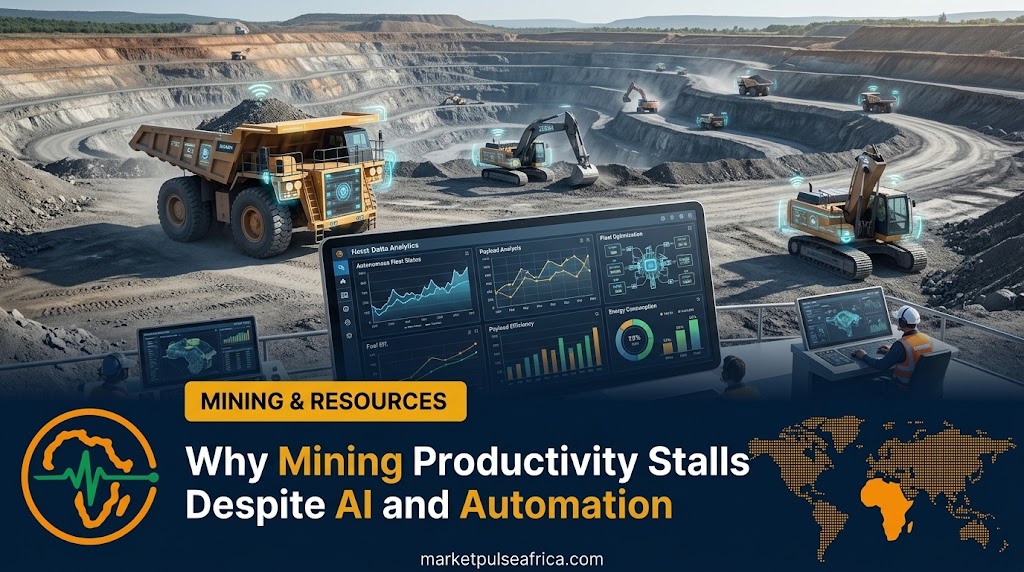
Mining productivity did not improve in 2025, even as miners expanded their use of automation, artificial intelligence and robotics, according to McKinsey's Global Materials Perspective 2026. The report says productivity in metals and mining flatlined after a brief rebound following COVID-19, with labour productivity unchanged and capital productivity declining. McKinsey estimates that better use of these technologies could be worth $450 billion to $750 billion a year across the industry, or 15 to 25 percent of 2025 revenue, if captured at scale. The gap between what the technology can do and what operators are actually achieving is the report's central finding. For miners and investors, the message is that adopting new tools is not enough on its own. The gains depend on how widely and how well those tools are put to work.
Contents
- Productivity stalls despite new technology
- Uneven adoption of autonomous haulage
- The $450 billion to $750 billion opportunity
- Rising costs of finding new minerals
- A slump that predates the latest technology
- What it means for miners and investors
Productivity stalls despite new technology
McKinsey's report, published in mid-October 2026, describes a sector with record financial results but little improvement in how efficiently it produces. Metals and mining market capitalization reached a record $3.7 trillion, roughly 230 percent higher than in 2015, and average EBITDA margins reached 27 percent. Yet revenues grew only around 1 percent in 2025, volumes were largely flat, and labour productivity was unchanged. The report attributes much of the headline strength to gold, with the benefits concentrated among a smaller group of producers.
The report's authors say the industry's problem is not a lack of tools. The application of artificial intelligence, advanced analytics and automation has yet to translate into sustained, industry-wide gains. Karel Eloot, a senior partner at McKinsey, said the next productivity frontier in metals and mining is technology-enabled, and that AI, analytics, automation and robotics can lift performance beyond what conventional improvement can deliver.
Uneven adoption of autonomous haulage
The clearest sign of progress is in autonomous haulage. The industry's fleet of autonomous trucks has nearly tripled in the past two years, according to the report. That is a real shift in how ore moves around mines. But McKinsey says the rollout has been uneven, with China often moving faster than other regions.
That unevenness matters for competitiveness. The report warns that operators and regions that scale autonomy and integrate it into mine planning and maintenance may pull ahead, while laggards may fall further behind even as the technology becomes mainstream. In other words, a technology that is widely available does not automatically become a competitive advantage for everyone who buys it. Companies that deploy it well, and connect it to planning and maintenance, are the ones likely to see the gains.
The $450 billion to $750 billion opportunity
McKinsey puts the untapped annual productivity opportunity at $450 billion to $750 billion across the metals and mining industries. That figure equals 15 to 25 percent of industry revenue in 2025, if captured at scale. The report identifies opportunities across throughput, recovery, procurement and capital efficiency, rather than in any single area.
The number is large, and it should be read as a potential rather than a forecast. It assumes that companies can scale technologies that are still being integrated into operations. It also assumes that the gains will be shared widely enough to matter for the industry as a whole, not just for the most advanced operators.
Rising costs of finding new minerals
The report also points to a growing problem upstream. McKinsey says exploration spending is flat while the cost per discovery has risen more than fivefold. That means the industry is spending about the same to find new deposits but finding far fewer of them. The report links this to the broader supply question: capital on company balance sheets does not guarantee that new mines or discoveries will follow at the pace the energy transition requires.
McKinsey estimates that about $4.2 trillion in capital expenditure may be needed across mining and processing through 2035. Productivity gains and new discoveries are both needed to meet that requirement, and the report suggests that neither can be taken for granted.
A slump that predates the latest technology
The productivity problem is not new. An earlier McKinsey report, published in 2025 under the title "Unearthing a new era of innovation in mining," found that mining productivity has roughly halved since 1997, while manufacturing productivity more than doubled over the same period. That earlier report said productivity has improved only about 1 percent a year since 2018. It attributed part of the slowdown to deeper pits, longer haul distances, declining ore grades and remote operating conditions.
The 2026 findings suggest the trend has not reversed. New technology has arrived, but it has not yet produced the broad gains that would reverse the long decline.
What it means for miners and investors
For African mining economies, the findings raise a practical question. Many of the continent's largest producers are in gold, copper, cobalt, lithium and other metals where costs, grades and access to capital shape investment decisions. McKinsey's report does not single out African operators in the summary coverage available, so readers should check the full report before drawing conclusions for specific countries or companies. But the broad message applies: operators that adopt technology well and integrate it into planning and maintenance may gain a lasting advantage over those that do not.
For investors, the report suggests that headline profits in the sector can hide weak underlying productivity. A miner with record margins may still be struggling to expand output efficiently. Readers following African mining stocks should look past share price moves and ask whether management is turning technology spending into measurable gains in throughput, recovery and cost per unit.