Somalia Confirms Uranium, Lithium and Cobalt Deposits as It Courts Foreign Investor
Somalia has confirmed uranium, lithium and cobalt deposits as it seeks foreign investment — here's what's known, and what isn't, about the find.
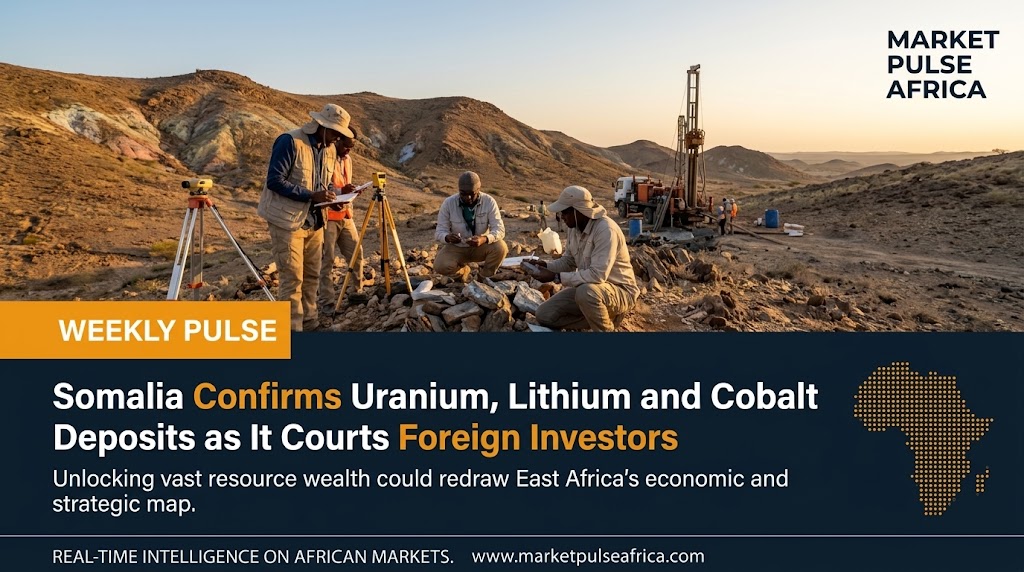
Somalia Confirms Uranium, Lithium and Cobalt Deposits as It Courts Foreign Investors
Somalia has confirmed the presence of uranium, lithium and cobalt within its borders, President Hassan Sheikh Mohamud announced over the weekend, as Mogadishu steps up efforts to position its largely untapped mineral wealth as a new pillar of the country's economic development strategy.
What Happened
Speaking Saturday, September 19, 2026, at the opening of the Somalia Development Financing Forum in Mogadishu, President Mohamud told delegates that global demand for critical minerals had made Somalia's own deposits newly relevant. He said the world's growing interest in minerals such as uranium, lithium and cobalt had led to confirmation that these resources exist within Somalia, alongside other minerals the world is actively seeking.
The president did not disclose the size, precise location, or commercial viability of the confirmed deposits, and no specific mining project has been identified for either lithium or cobalt. Somalia's Ministry of Petroleum and Mineral Resources separately lists a broader range of resources believed to exist in the country, including iron ore, copper, tin, gold, bauxite, phosphates, gypsum and salt — though, as with the newly confirmed deposits, most remain unquantified and unexploited.
Beyond underground minerals, Mohamud used the forum to promote Somalia's wider resource base, including offshore oil and gas prospects, fisheries, livestock and agricultural potential. He emphasized that developing any of these sectors will require external investment, technical expertise and international cooperation that Somalia currently lacks the domestic capacity to provide on its own.
Historical Context
Somalia's push to attract extractive-sector investment fits into a broader economic reform effort under Mohamud's government, anchored by the country's National Transformation Plan 2025–2029 and longer-term National Vision 2060, both aimed at diversifying an economy that remains heavily reliant on imports, remittances and international assistance. Days after the mineral announcement, Somali officials also outlined plans to reduce the country's roughly $9 billion in annual import spending, underscoring how the government is framing natural resource development as part of a wider push for greater economic self-sufficiency.
The country's institutional foundations for managing resource wealth remain a work in progress. According to the U.S. State Department's 2026 Fiscal Transparency Report, Somalia has established legal criteria and procedures for awarding natural resource extraction licenses, but a lack of transparency — particularly around hydrocarbon agreements — makes it difficult to independently verify whether those rules are consistently followed in practice.
Why It Matters for Africa
Somalia's announcement adds another entrant to a growing list of African nations positioning themselves in the global critical minerals race, alongside established producers such as the Democratic Republic of Congo (cobalt), Zambia and Zimbabwe (lithium and copper), and Namibia (uranium). Global demand for these minerals — driven by electric vehicle batteries, renewable energy infrastructure and nuclear power — has made resource-rich African nations increasingly attractive to investors seeking supply diversification away from geopolitically concentrated sources.
For Somalia specifically, translating confirmed deposits into actual investment and production faces significant headwinds that the government itself has acknowledged: security threats from al-Shabaab insurgents, weak physical infrastructure, high electricity costs, and an aging legal framework governing the mining sector. Mohamud was direct about this, telling the forum that investor confidence depends on security, clear regulations and effective institutions — conditions Somalia is still building rather than a finished offering.
For the broader continent, Somalia's entry into the critical minerals conversation — however preliminary — reinforces a trend of African governments explicitly marketing resource wealth as an investment thesis, rather than treating mineral development as a purely technical or bureaucratic matter. Whether that marketing translates into capital commitments will depend heavily on whether Somalia can address the institutional and security gaps that have historically deterred large-scale extractive investment in the country.
Market Data & Key Numbers
Metric | Detail |
|---|---|
Announcement date | September 19, 2026 |
Confirmed minerals | Uranium, lithium, cobalt |
Deposit size / location disclosed | Not disclosed |
Commercial viability assessment | Not disclosed |
Other listed mineral resources | Iron ore, copper, tin, gold, bauxite, phosphates, gypsum, salt |
Somalia's annual import bill | ~$9 billion |
Governing strategy documents | National Transformation Plan 2025–2029; National Vision 2060 |
What Businesses and Investors Should Watch
Follow-up technical data from Somalia's Ministry of Petroleum and Mineral Resources on deposit size, location and grade — none of which has been published yet.
Security conditions, particularly in regions where mineral deposits may be located, given ongoing al-Shabaab activity.
Regulatory and licensing framework updates, since Somalia's current mining legislation is widely described as outdated.
Parallel developments in offshore oil and gas, which the government is promoting alongside minerals as part of the same investment push.
Regional critical minerals competition, including how Somalia's offering compares with more established producers like the DRC, Zambia and Namibia.
Practical Guide: Key Takeaways
For Businesses
Treat this announcement as an early-stage signal of government intent rather than an investable opportunity — no feasibility data has been released.
Monitor Somalia's regulatory reform pace, since clear rules and licensing procedures are prerequisites the government itself has flagged as missing.
For Investors
Weigh Somalia's security and infrastructure risk profile carefully against the appeal of an unexploited, first-mover mineral opportunity.
Compare Somalia's stage of development against neighboring Ethiopia, which is also investing in critical minerals, when assessing regional entry points.
For General Readers
Understand that a government "confirming" mineral deposits is a preliminary geological finding, not proof of a commercially viable, ready-to-develop resource.
Somalia's push reflects a broader African pattern: countries with limited current extractive industries are increasingly marketing potential mineral wealth to attract the capital and expertise needed to actually develop it.
How MarketPulse Africa Helps
Early-stage resource announcements like Somalia's can be difficult to evaluate without context on the country's investment climate, regulatory environment and regional competition for capital. MarketPulse Africa tracks critical minerals developments across the continent alongside broader investment and macroeconomic trends, helping readers separate genuine investment openings from preliminary government announcements still awaiting the technical and institutional groundwork to follow through.
Conclusion
Somalia's confirmation of uranium, lithium and cobalt deposits marks a notable — if still very early — step in the country's effort to position itself within the global critical minerals economy. With no deposit data yet published and significant security and institutional challenges still unresolved, the announcement is best read as a statement of intent rather than an imminent investment opportunity. Follow MarketPulse Africa for continued coverage as Somalia's mineral sector development, and the broader African critical minerals race, unfolds.