WORLD IN BRIEF: France to close 500 schools amid protests, 12-year-old killed in Baltimore shooting, Cameroon secures $391m World Bank loan and other stories
World news in brief covers France’s school protests, a deadly Baltimore shooting, renewed Tigray fighting, Congo’s Ebola crisis and Cameroon’s $391m World Bank loan.
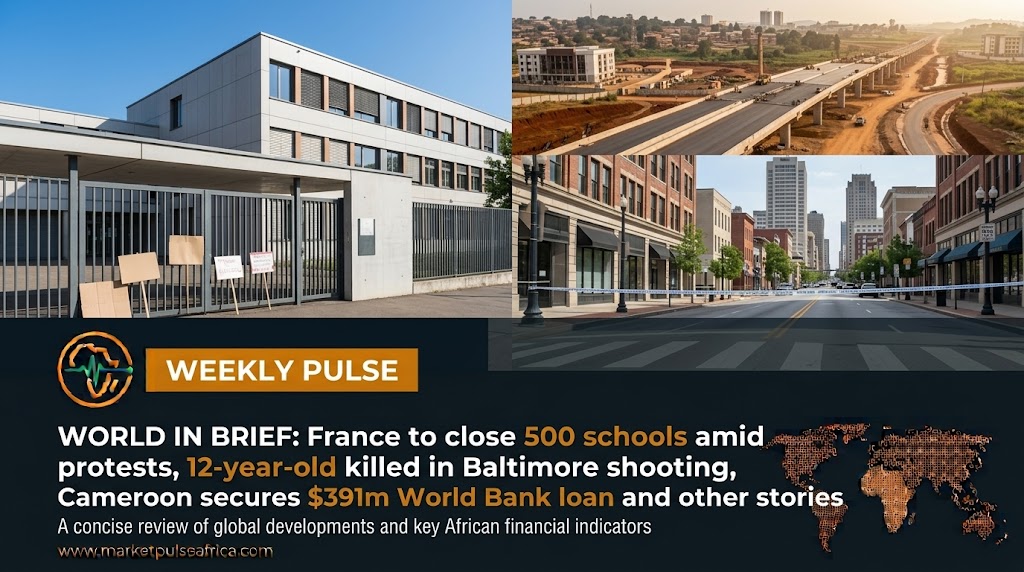
WORLD IN BRIEF: France to close 500 schools amid protests, 12-year-old killed in Baltimore shooting, Cameroon secures $391m World Bank loan and other stories
Global developments are moving quickly across geopolitics, security, public policy, infrastructure and the economy. From renewed conflict in Ethiopia and school protests in France to a deadly shooting in Baltimore and fresh infrastructure financing for Cameroon, several developments are shaping the international news cycle.
For African markets, some of these stories carry direct economic implications. Infrastructure financing, political instability, public health emergencies and regional security developments can influence trade, investment flows, government spending and business confidence.
Here are the key developments to watch.
Russia-Ukraine war: Russian drones strike Kyiv bridge as German leader visits
Russian drones struck a major bridge in Kyiv on Sunday for the second consecutive day, damaging a traffic lane and disrupting movement across the Ukrainian capital.
The Pivnichnyi Bridge was reportedly hit while German Chancellor Friedrich Merz was visiting Ukraine, where he reaffirmed Germany's support for the country. The strikes were part of a wider pattern of attacks on important bridges across the Dnipro River.
Ukrainian officials said the attacks caused significant traffic disruption and also damaged a heating pipeline, affecting hot-water supplies in parts of the capital.
Russia said the bridges were being targeted because of their alleged use in transferring Ukrainian troops. Ukrainian authorities have continued working to restore transport links.
The latest attacks highlight the continuing vulnerability of critical infrastructure in the war and the economic costs associated with maintaining transport and energy networks during prolonged conflict.
For African economies, the broader implications remain important because the Russia-Ukraine conflict has previously affected global energy, food and fertiliser markets. Changes in commodity prices and shipping conditions can quickly feed into African import bills, inflation and government budgets.
Yemen government announces campaign against Houthi-held territory
Yemen's internationally recognised government has announced an all-out military campaign aimed at retaking territory controlled by the Houthi movement.
President Rashad al-Alimi said the government intended to restore state authority across areas held by the Houthis after renewed fighting and territorial advances.
The development comes amid continuing tensions around the strategically important Bab al-Mandab Strait, a major maritime route connecting the Red Sea with the Gulf of Aden.
The security of the waterway remains important for international trade because disruptions can increase shipping costs, extend voyage times and affect insurance premiums.
For African economies, particularly those dependent on imported fuel and goods, instability around major shipping routes can have consequences beyond the immediate conflict zone. Higher freight costs can increase the landed cost of commodities and manufactured products.
France to close up to 500 schools amid student protests
France could partially or completely close as many as 500 schools as student protests over education conditions continue to spread.
French Education Minister Édouard Geffray said between 400 and 500 high schools could suspend lessons because security conditions could not be guaranteed. He also said 24 schools had been burned or vandalised since the demonstrations began.
Students have protested over teacher shortages, overcrowded classrooms, long school days and deteriorating school facilities.
The demonstrations have spread beyond Paris to cities including Montpellier, Nantes and Marseille. Further protests have been expected as organisers continue to press the government over education standards and working conditions.
The issue is primarily domestic, but it illustrates the economic importance of public infrastructure and human capital. Education disruptions can affect labour productivity, household arrangements and the long-term quality of a country's workforce.
For African governments facing similar pressures over education infrastructure and teacher shortages, the French protests also highlight the economic consequences that can arise when public-service investment falls behind demand.
12-year-old girl killed in Baltimore shooting
A 12-year-old girl was killed after being caught in the crossfire of a shooting at a Baltimore park during a youth football game.
According to police, two men allegedly began shooting at each other following an argument believed to have involved a parking space. The girl and a woman were struck by gunfire.
The girl was taken to hospital but later died. The woman and the two men involved reportedly suffered injuries that were not life-threatening.
Baltimore police said the child was not believed to have been the intended target and appealed to witnesses for information as investigators searched for suspects.
The shooting has renewed concerns about the consequences of gun violence in communities and the vulnerability of children and other bystanders when disputes escalate into armed confrontations.
Ethiopia: Tigray conflict raises fresh regional concerns
Renewed fighting in Ethiopia's Tigray region has taken a significant turn, with government forces and allied fighters regaining control of Mekelle, the regional capital.
The Tigray People's Liberation Front said its forces had withdrawn from the city and that the regional administration would temporarily operate from elsewhere.
The development follows renewed fighting that began in September and represents the most serious escalation since Ethiopia's devastating 2020–2022 Tigray war.
The renewed conflict is significant beyond Ethiopia's borders. Tigray sits within a strategically important part of the Horn of Africa, where political tensions can intersect with trade routes, regional security and relations involving Eritrea, Sudan and Egypt.
The possibility of a wider conflict could increase humanitarian pressures and disrupt economic activity in an already fragile region.
Markets will be watching developments closely because prolonged instability can affect transport, agricultural production, investment decisions and government spending.
Congo Ebola outbreak death toll exceeds 4,000
The Democratic Republic of Congo is facing a major Ebola outbreak, with government data showing 4,018 deaths and 8,300 confirmed cases across seven provinces.
The outbreak, caused by the Bundibugyo strain of Ebola, has become the largest and deadliest Ebola outbreak in the country's history, according to reported government figures.
More than 2,000 people have recovered, while health authorities and international organisations continue efforts to contain transmission.
Although there have been signs of slowing transmission in parts of Ituri, the disease continues to spread in eastern areas, including North Kivu.
The economic consequences of major health emergencies can extend well beyond the healthcare sector. Outbreaks can disrupt movement, trade, tourism, labour supply and household incomes while increasing pressure on public finances.
For African economies, public-health capacity remains closely connected to economic resilience. The scale of the Congo outbreak reinforces the importance of disease surveillance, emergency preparedness and healthcare investment.
Cameroon secures $391 million World Bank financing for trade corridor
Cameroon has authorised a €347.5 million, equivalent to about $390.9 million, World Bank loan to support the Douala-Bangui Economic Corridor.
The financing was authorised through a presidential decree issued on October 2 and is intended to support the development of the corridor linking Cameroon's commercial capital, Douala, with Bangui in the Central African Republic.
The project has major regional significance because the Douala-Bangui corridor is a critical transport and trade route connecting Central African markets to Cameroon's Atlantic port infrastructure.
The World Bank previously approved a broader $1.12 billion programme in June 2026 to modernise the corridor, with the first phase targeting priority infrastructure rehabilitation, road safety and maintenance reforms in Cameroon, the Central African Republic and the wider CEMAC region.
The World Bank said the corridor stretches more than 1,400 kilometres and carries more than 80 percent of the Central African Republic's external trade. It also highlighted high transport costs, long journey times and numerous checkpoints as major constraints on trade.
The latest financing therefore has implications beyond road construction.
Better infrastructure can reduce transportation costs, improve the movement of agricultural products and manufactured goods, strengthen access to markets and support regional trade.
For Cameroon, the project could also reinforce the strategic importance of Douala as a gateway for Central African commerce.
For businesses, the development is particularly important because logistics costs remain a major factor affecting competitiveness across many African markets. Improving road infrastructure and reducing bottlenecks can make regional supply chains more efficient.
Guinea-Bissau blocks former president's return
Military authorities in Guinea-Bissau have blocked former President Umaro Sissoco Embalo from returning to the country, citing security concerns.
Embalo had planned to return after being ousted in a military coup and had intended to contest a presidential election scheduled for December.
The decision adds another layer of uncertainty to the country's political transition.
Political instability can have significant economic consequences in smaller economies, particularly when uncertainty affects government institutions, foreign investment, development financing and trade.
For West Africa, developments in Guinea-Bissau also matter because repeated political disruptions can complicate regional efforts to maintain democratic governance and economic stability.
US waives human-rights conditions on $320 million Egypt military aid
The United States has waived human-rights conditions attached to $320 million in military assistance to Egypt, citing security and national-interest considerations.
The decision represents a shift in Washington's approach to part of its military assistance relationship with Cairo.
Egypt has received substantial US military assistance for decades, with the relationship tied to regional security and the country's strategic position in the Middle East and North Africa.
The development highlights the continuing importance of geopolitical considerations in determining international aid and security partnerships.
For African governments, the broader issue is significant because foreign assistance, security partnerships and diplomatic relationships can influence national budgets and regional security arrangements.
Australia investigates Flydubai co-pilot incident
Australian authorities are investigating the connections of a Flydubai co-pilot accused of attacking the captain and attempting to take control of a flight travelling from Dubai to Tel Aviv.
The incident occurred on September 30, when the co-pilot allegedly attacked the captain with a crash axe. Passengers and crew members reportedly subdued him, allowing other pilots to land the aircraft safely in Saudi Arabia.
Australian authorities confirmed they were examining the man's links to the country in cooperation with law-enforcement and security agencies.
The incident is likely to renew attention on aviation security, crew screening and the management of security risks involving international air travel.
What these developments mean for Africa
Taken together, the stories show how political, security and economic developments remain closely connected.
For African businesses and investors, several areas deserve attention.
Infrastructure and trade
Cameroon's Douala-Bangui financing is particularly relevant because better transport infrastructure can directly affect the cost and speed of moving goods across Central Africa.
The success of the project will depend not only on construction but also on maintenance, road safety, trade facilitation and efforts to reduce logistical bottlenecks.
Regional security
The renewed fighting in Ethiopia demonstrates how quickly political tensions can become broader economic risks.
Conflict can disrupt agricultural activity, trade routes, labour markets and investment while increasing government spending on security and humanitarian needs.
Public health
The Ebola outbreak in the Democratic Republic of Congo demonstrates the economic importance of healthcare systems.
Large-scale outbreaks can place pressure on government finances while disrupting economic activity and cross-border movement.
Global trade and shipping
Developments in Yemen and Ukraine also matter because both are connected to important international trade and logistics networks.
African importers and exporters remain exposed to changes in freight costs, fuel prices, insurance premiums and shipping routes.
What businesses and investors should watch
Market participants should continue monitoring developments that could influence economic conditions across Africa and globally.
These include:
Infrastructure investment and regional trade corridors
Political stability in key African economies
Global energy and shipping costs
Public-health emergencies and their economic effects
Government borrowing and infrastructure spending
Regional security developments
Foreign investment flows
Currency movements and inflation
Commodity prices and international demand
The key point is that global news does not remain confined to the countries where events occur. Changes in security, infrastructure, public policy and international trade can eventually influence African companies, governments and consumers.
How MarketPulse Africa helps readers follow the bigger picture
MarketPulse Africa provides real-time intelligence on African markets, covering the developments that matter to businesses, financial professionals, investors and policymakers.
From currencies and commodities to equities, central-bank policy, trade, infrastructure and corporate developments, the platform connects individual stories to the wider African economic picture.
For readers following global developments such as the ones covered in this world news brief, that regional perspective is important. A geopolitical event in Europe or the Middle East can affect commodity prices, shipping costs or currencies, while an infrastructure decision in Central Africa can influence regional trade and investment.
MarketPulse Africa brings these developments together to help readers understand how international events intersect with African markets.
Conclusion
The latest global news cycle underscores how closely connected security, economics, infrastructure and public policy have become.
France's school protests highlight pressure on public services, while the Baltimore shooting illustrates the continuing human cost of violence. Renewed fighting in Ethiopia and the Ebola outbreak in Congo show the economic consequences of instability and public-health emergencies.
For Africa, however, Cameroon's $391 million World Bank financing stands out as a potentially important development for regional trade. The Douala-Bangui corridor is a critical economic link, and investment in its infrastructure could help reduce some of the logistical barriers affecting Central African commerce.
Businesses, investors and policymakers should therefore look beyond individual headlines and monitor the wider forces shaping markets, trade and economic activity.
Follow MarketPulse Africa for continued coverage and real-time intelligence on African markets.