Dangote and Ruto break ground on $16bn Kenyan refinery
Dangote and Kenyan President Ruto broke ground on a $16bn Lamu refinery, despite an active land dispute — here's what the project aims to deliver by 2030.
Dangote and Ruto Break Ground on $16bn Kenyan Refinery
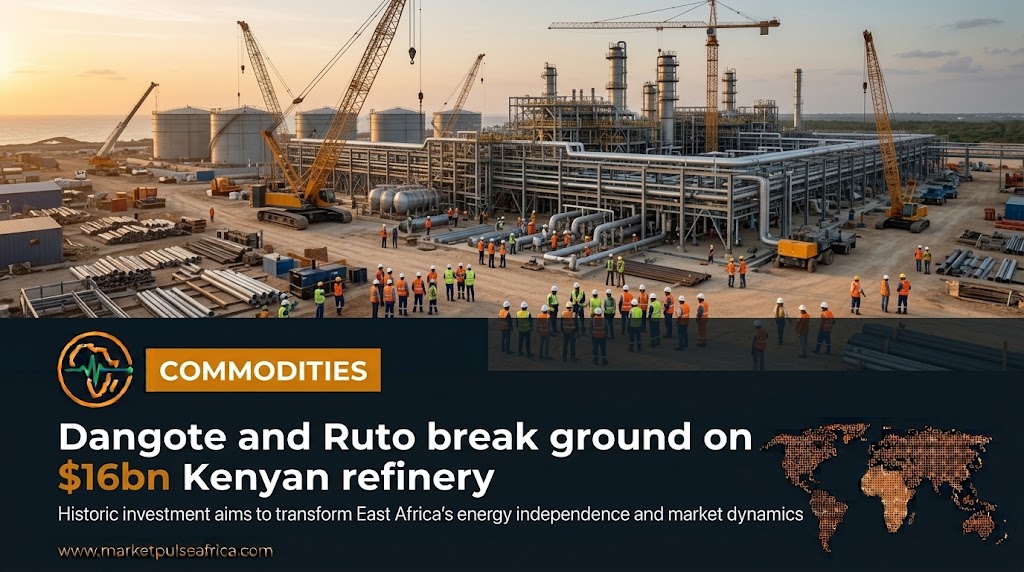
A refinery doesn't need to produce a single barrel of fuel to already be controversial. On September 30, Aliko Dangote and Kenyan President William Ruto broke ground on a planned $16 billion refinery at Lamu on Kenya's northern coast — a project both men are framing as the next chapter in Dangote's African refining ambitions, even as an active court case over the land it sits on remains unresolved.
What Happened
The groundbreaking ceremony at Lamu drew a notable regional crowd: Dangote, Ruto, Uganda's President Yoweri Museveni, and former Nigerian President Olusegun Obasanjo all attended what's being called the Dangote East Africa Petroleum Refinery. The price tag depends on who's quoting it. Kenya's government has pegged the project at 2.2 trillion Kenyan shillings, roughly $17 billion. Reuters has reported $16 billion. Dangote himself has previously cited $20 billion. That spread is itself a signal of how early-stage the project's final costing remains.
Ruto called it the largest foreign direct investment in Kenya's history and said it would lift the country's annual GDP by 12%. The complex will come with its own 1,000-megawatt power plant, and Dangote told Ruto days before the ceremony that he plans to sell half of that capacity — 500 megawatts — directly to the Kenyan government, stretching the project's reach well past fuel production into domestic power supply. Dangote has also offered regional governments a combined 30% stake in the refinery, with shares eventually expected to list on the Nairobi Securities Exchange, following the same path his Nigerian refinery took onto the NGX earlier this year. Completion is targeted for 2030.
The Land Dispute Still Running in the Background
Construction began under the shadow of an active legal fight. A court ruling published just two days before the ceremony cleared the way for groundbreaking to proceed, but the underlying case over land acquisition, compensation and environmental concerns remains open. Local landowners have protested the project; Dangote has dismissed the opposition as the work of local fuel marketers and international competitors trying to slow him down. Separately, Ndindi Nyoro, leader of Kenya's People's Party, has publicly demanded the government disclose exactly who will own shares in the refinery.
There's a second, more structural question hanging over the project: Kenya doesn't currently produce oil. Kenya's Energy and Petroleum Minister, Opiyo Wandayi, has said the refinery won't depend exclusively on regional crude, while Ruto has pointed to work underway on a transport corridor to move crude from Kenya's Turkana fields to Lamu as that supply develops.
Historical Context
The Kenyan project is a direct sequel to Dangote's Nigerian refinery, inaugurated in 2023 after years of delays, crude-supply disputes and — by Dangote's own repeated account — resistance from entrenched import interests. That facility's recent NGX debut, Africa's largest-ever IPO, gave Dangote both the operating proof point and the capital-markets credibility to pitch something even bigger to a neighbouring government. Lamu is also meant to reinforce the long-planned Lamu Port-South Sudan-Ethiopia Transport (LAPSSET) Corridor, linking Kenya's coast to its interior and to landlocked neighbours.
Why It Matters for Africa
East Africa's reliance on imported fuel is the real target here. Regional demand for petroleum products runs between 20 million and 30 million metric tons a year, according to Ruto's chief economic adviser David Ndii — almost all of it currently imported across a market the refinery is meant to serve spanning Kenya, Uganda, South Sudan, Rwanda, Burundi and the Democratic Republic of Congo. A facility at this scale, if it gets built on schedule, would cut into the hard-currency spending those countries currently funnel into refined fuel imports, echoing the same foreign-exchange logic behind Dangote's original Nigerian refinery.
The bigger test is whether that Nigerian model — privately financed mega-refining capacity, paired with local government equity and an eventual stock exchange listing — actually transfers to a market without Nigeria's starting advantage of being a major crude producer. Kenya isn't one, at least not yet. That makes the refinery's crude-sourcing strategy, not its construction timeline, the thing most likely to determine whether it succeeds. The stated ambition to also export jet fuel to European and British markets adds another layer: this isn't pitched purely as import substitution, but as a bid to compete in international fuel markets too.
Market Data & Key Numbers
Metric | Figure |
|---|---|
Project cost (Reuters) | $16 billion |
Project cost (Kenyan government) | KSh2.2 trillion (~$17 billion) |
Project cost (Dangote's figure) | $20 billion |
Groundbreaking date | September 30, 2026 |
Targeted completion | 2030 |
Power plant capacity | 1,000 MW (500 MW earmarked for Kenya) |
Regional government stake offered | Up to 30% combined |
Estimated peak construction jobs | ~60,000 |
Regional annual fuel demand | 20–30 million metric tons |
Claimed GDP boost for Kenya | 12% annually (Ruto's estimate) |
What Businesses and Investors Should Watch
How the land dispute court case resolves, given construction has started but the underlying legal question hasn't.
Crude feedstock arrangements, including progress on the Turkana-to-Lamu transport link.
Ownership disclosure, following public calls for the government to publish the full shareholder structure.
Financing and construction milestones across the multi-year build to 2030, given the unsettled cost figures.
Eventual NSE listing terms, once Dangote moves to replicate the NGX listing structure in Kenya.
Practical Guide: Key Takeaways
For Businesses
East African construction, logistics and engineering firms should track procurement activity as the project moves from groundbreaking into active building.
Fuel-dependent businesses across Kenya, Uganda and neighbouring states should watch for long-term effects on regional supply security and pricing.
For Investors
Treat the cost estimates as provisional — a $4 billion gap between the lowest and highest publicly cited figures isn't a rounding error.
Compare the eventual NSE listing structure against the Dangote Nigerian refinery's NGX offering once terms are confirmed.
For General Readers
A groundbreaking ceremony marks the start of construction, not the finish — this refinery isn't expected to be running before 2030.
An unresolved court case over the land means legal risk hasn't gone away just because building has started.
How MarketPulse Africa Helps
Projects on this scale reshape regional energy security and capital markets long after the ceremony ends. MarketPulse Africa tracks major African infrastructure investment alongside our continued coverage of Dangote Group's expansion, following announcements like this one through to what actually gets built.
Conclusion
Tuesday's ceremony at Lamu marks the formal start of what could become East Africa's largest industrial project — built on a model Dangote has already proven once in Nigeria. But between an unresolved land dispute, a cost estimate that swings by $4 billion depending on the source, and a crude-supply plan still being worked out for a country that doesn't yet produce its own oil, there's a long distance between Tuesday's groundbreaking and a refinery actually running in 2030. Follow MarketPulse Africa for continued coverage as construction moves forward.