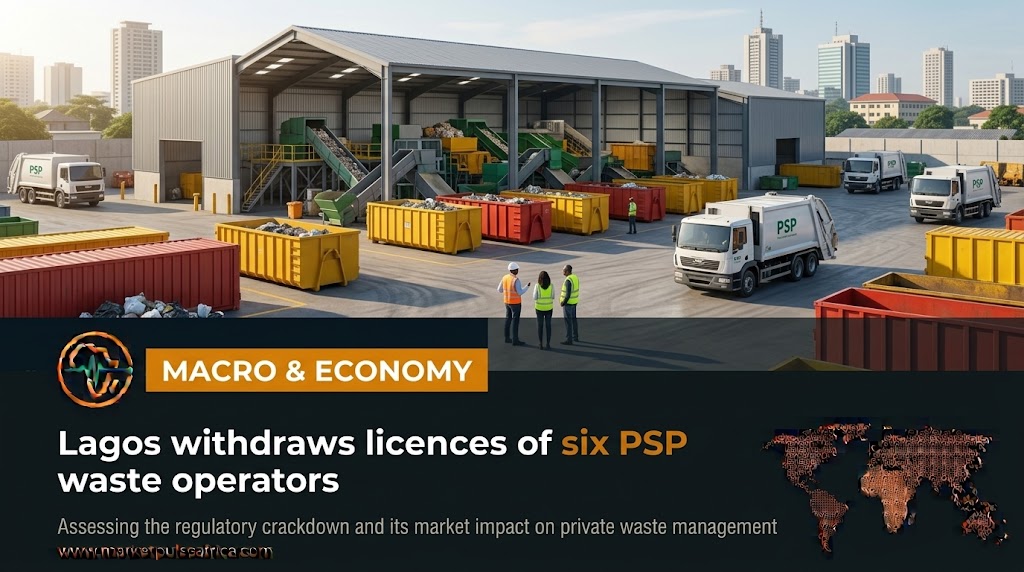
Lagos withdraws licences of six PSP waste operators
Lagos State has withdrawn the operating licences of six PSP waste operators after capacity shortfalls. One exited voluntarily; five were terminated. Service continuity has been promised.
The Lead
In a city that generates thousands of tonnes of waste daily, reliable collection is not optional. When private operators fall short, streets clog, public health risks rise, and resident confidence erodes.
The Lagos State Government, through the Lagos Waste Management Authority (LAWMA), has withdrawn the operating licences of six Private Sector Participation (PSP) waste operators for lacking the capacity to deliver effective collection services in their assigned areas.
One operator voluntarily exited while the licences of the remaining five were terminated. This article explains exactly which operators and locations are affected, why the action was taken, how service continuity will be protected, and what the move signals for waste management accountability in Lagos and across African cities.
Table of Contents
- Why the Licences Were Withdrawn
- The Six Operators and Their Service Areas
- Immediate Impact on Residents
- LAWMA’s Reform Agenda and Enforcement Pattern
- Implications for the PSP Model and Private Operators
- Practical Guidance for Residents and Stakeholders
- Next Steps and Related Reading
Why the Licences Were Withdrawn
On 6 October 2026, Lagos State Commissioner for Environment and Water Resources Tokunbo Wahab announced the decision, which was confirmed by LAWMA Managing Director Dr Muyiwa Gbadegesin during a management briefing.
Official statements made clear that the operators did not meet the required standards of capacity, competence and resources needed to provide reliable waste collection. The action forms part of the state government’s broader commitment to a cleaner, healthier and more sustainable environment.
LAWMA has previously withdrawn licences and realigned routes when performance gaps were identified. This latest step continues a pattern of tighter regulatory oversight rather than a one-off measure. For ongoing coverage of Lagos regulatory and environmental developments, readers can follow MarketPulse Africa.
Key Takeaway
- The withdrawals were driven by sustained capacity shortfalls, not isolated incidents.
- Five licences were terminated by LAWMA; one operator exited voluntarily.
- Service continuity in the affected communities remains a stated priority.
The Six Operators and Their Service Areas
The affected operators and locations are:
- K-HS Integrated Services (formerly Gboleybos Nigeria Limited) – Ward C1, Slot A, Abosan in Igbogbo-Baiyeku (voluntarily withdrew)
- Deshasat Enterprises – Ibereko (LIMCA) in Olorunda
- Bailas Nigeria Company – Sabo Oniba in Ojo
- Guestimate Environmental Protection Company – Papa Ashafa II in Orile Agege
- Evabol Ventures – Oluwa 1 in Ajeromi-Ifelodun
- Korad Closet Empire Limited – Oke-Ira/Powerline in Ojodu
These details have been consistently reported across official statements and independent coverage, including Nairametrics and Punch.
Immediate Impact on Residents
LAWMA has assured residents that alternative arrangements will be activated to prevent disruption of waste collection in the six locations. Residents have been urged to continue using only approved waste management channels and to support collective efforts aimed at keeping Lagos clean.
In a dense urban environment, even short interruptions can lead to illegal dumping and environmental hazards. The explicit commitment to continuity is therefore critical for public confidence during the transition period.
Broader analysis of how African cities manage urban service delivery challenges can be found on the MarketPulse Africa blog.
LAWMA’s Reform Agenda and Enforcement Pattern
The licence withdrawals form part of a wider effort to strengthen the Private Sector Participation model. LAWMA has emphasised stronger performance standards, expanded coverage, improved accountability and more effective regulatory oversight.
Similar enforcement actions earlier in 2026 involved both licence withdrawals and route realignments. The consistent application of capacity requirements indicates a shift from simple route allocation toward measurable service delivery standards.
This approach is relevant beyond Lagos. Other African cities observing the PSP model will note how regulatory follow-through can either reinforce or undermine private participation in essential public services.
Implications for the PSP Model and Private Operators
The PSP scheme depends on private companies delivering door-to-door and area-based collection across designated zones. When operators cannot meet capacity requirements, the credibility of the entire system is affected.
For remaining operators the message is unambiguous: equipment, staffing, operational systems and consistent performance will continue to be assessed. For potential new entrants, the threshold for obtaining and retaining a licence is being raised.
The enforcement also highlights the importance of matching operator capacity to the scale of demand in rapidly growing communities. Where development has outpaced a single operator’s ability to serve, redistribution of responsibilities becomes necessary.
Practical Guidance for Residents and Stakeholders
For residents in the affected areas
- Expect transition arrangements while new or existing operators assume responsibility.
- Use only verified LAWMA-approved collection channels.
- Report persistent service gaps through official platforms so they can be addressed promptly.
For private waste operators
- Capacity assessments are ongoing and non-negotiable.
- Sustained investment in equipment, personnel and systems is required to retain routes.
- Voluntary exit remains available when capacity gaps become clear.
For policymakers and observers
- Consistent enforcement builds long-term system credibility.
- Service continuity planning must accompany any licence withdrawal.
- Transparent communication reduces resident anxiety during transitions.
Next Steps and Related Reading
The withdrawal of six PSP licences underscores Lagos State’s determination to enforce capacity standards in waste collection. Residents in the affected communities have been assured that services will continue, while operators across the system have been reminded that performance is actively monitored.
- Follow further updates on Lagos environmental regulation and urban services on MarketPulse Africa.
- Review related coverage of African city governance and infrastructure delivery on the MarketPulse Africa blog.
- Track how private-sector participation models evolve under stronger regulatory oversight.
How has waste collection reliability affected your community or business operations in Lagos? Share your experience and join the conversation.