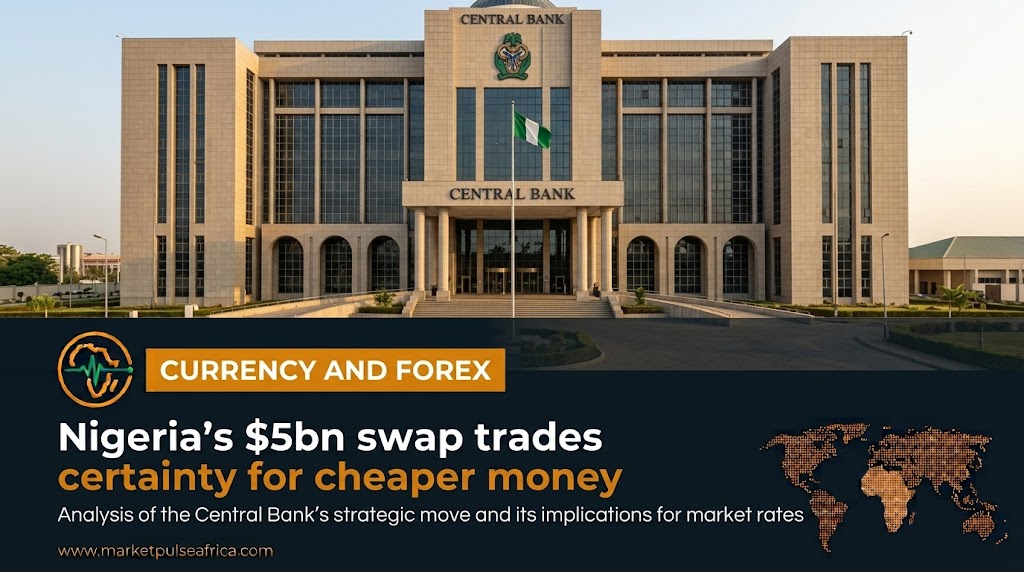
Nigeria’s $5bn swap trades certainty for cheaper money
Nigeria's $5bn swap with First Abu Dhabi Bank trades fixed-cost certainty for flexible dollar liquidity — here's how the deal actually works.
Nigeria's $5bn Swap Trades Certainty for Cheaper Money
Nigeria's $5 billion financing arrangement with First Abu Dhabi Bank is moving into a new phase, with the UAE lender now weighing whether to spread part of its exposure to other banks. The development puts fresh attention on a trade-off that has sat at the center of the deal since it was first announced: Nigeria has secured access to dollars, but not certainty over what those dollars will ultimately cost.
What Happened
The $5 billion facility, structured as a Total Return Swap (TRS) with First Abu Dhabi Bank (FAB), lets Nigeria draw dollar funding in stages rather than borrowing the full amount at once. The Federal Government has already pulled $1.5 billion as a first tranche in June 2026, leaving up to $3.5 billion still available through later drawdowns. FAB, the UAE's largest bank, is now considering syndicating part of its exposure to other lenders — a step that would spread the facility's risk beyond a single counterparty.
Under a total return swap, Nigeria pledges naira-denominated government securities as collateral, worth roughly 133% of the loan's value, while FAB provides the dollar financing in exchange. According to documents filed with the National Assembly, pricing is set at SOFR plus 3.95% for the first tranche and 4% for subsequent drawdowns — terms the government has described as competitive against prevailing Eurobond yields, which have stayed elevated amid Middle East-related market volatility. The facility carries a six-year tenor with a three-year break clause, and proceeds are earmarked for infrastructure spending and refinancing more expensive existing debt.
That staged structure is what separates the swap from a conventional Eurobond. A Eurobond locks in a fixed rate on the full amount at issuance; this facility leaves Nigeria's ultimate cost tied to where SOFR, the benchmark US dollar funding rate, moves over the life of the deal. If global dollar rates fall, Nigeria could end up paying less than a Eurobond would have cost. If they rise, the opposite is true. Nigeria has secured liquidity. It has not secured certainty.
Historical Context
The swap emerged in March 2026 as the Federal Government looked for foreign-currency financing options outside the traditional Eurobond market, at a moment when borrowing costs for emerging-market sovereigns had climbed broadly following the Iran conflict and bond issuance had largely stalled. Nigeria is not alone in turning to this kind of structure: Senegal and Angola have both tapped similar total return swap arrangements with international lenders over the past year, reflecting a wider pattern of African sovereigns seeking dollar liquidity through derivative-based financing rather than conventional bond sales.
The arrangement has drawn scrutiny from international institutions since it was first disclosed. Fitch Ratings warned in June 2026 that the transaction could obscure the true scale of Nigeria's sovereign debt risk and complicate any future debt restructuring, even while acknowledging that total return swaps can offer genuine financing flexibility and access to hard-currency liquidity that might otherwise be unavailable. The IMF has separately flagged concerns about transparency around the structure, and Nigerian analysts, including Akinola Ezekiel Morakinyo, have questioned the rationale for the swap given that the country's own foreign reserves have continued climbing, reaching roughly $54.6 billion as of early October 2026.
Why It Matters for Africa
Nigeria's experience with this facility is a live test case for a financing tool other African governments are increasingly turning to as Eurobond markets become more expensive or less accessible. The appeal is straightforward: a total return swap can deliver dollar liquidity without forcing a government to lock in a fixed rate during a period of elevated global borrowing costs, and it allows funds to be drawn only as needed rather than all at once. For countries managing currency pressure, infrastructure financing needs and expensive legacy debt simultaneously, that flexibility carries real value.
But the structure's opacity is precisely what has drawn Fitch's and the IMF's attention. Collateralized, derivative-based sovereign financing doesn't always appear on a government's balance sheet the same way conventional debt does, which can make it harder for investors, rating agencies and even domestic oversight bodies to assess a country's true debt exposure. For Nigeria specifically, reporting from Nairametrics notes that the National Assembly has already had to approve the transaction amid debt-management scrutiny — a sign that domestic institutions are treating the facility with the same caution international raters have applied.
For the broader West African and continental investment landscape, how this facility performs — whether FAB successfully syndicates its exposure, whether Nigeria draws the remaining $3.5 billion on favorable terms, and whether SOFR moves in Nigeria's favor over the six-year tenor — will shape how comfortably other African sovereigns lean on similar structures going forward.
Market Data & Key Numbers
Metric | Figure |
|---|---|
Total facility size | $5 billion |
Drawn to date | $1.5 billion (June 2026) |
Remaining available | Up to $3.5 billion |
Collateral (naira-denominated securities) | ~133% of loan value |
Pricing, first tranche | SOFR + 3.95% |
Pricing, subsequent tranches | SOFR + 4% |
Facility tenor | 6 years, with a 3-year break clause |
Nigeria's FX reserves | ~$54.6 billion (early October 2026) |
Counterparty | First Abu Dhabi Bank (FAB) |
What Businesses and Investors Should Watch
Whether FAB successfully syndicates part of its exposure, and to which institutions, as a signal of broader market appetite for Nigerian sovereign risk through this structure.
SOFR movements over the facility's life, since Nigeria's ultimate cost of funds is directly tied to the benchmark rate rather than fixed at drawdown.
Further tranche drawdowns, and whether pricing on later tranches holds steady or shifts.
Rating agency commentary, particularly any updated Fitch or Moody's assessments of how the swap affects Nigeria's overall sovereign debt profile.
Comparable deals from Senegal and Angola, as a reference point for how similar total return swaps are performing elsewhere on the continent.
Practical Guide: Key Takeaways
For Businesses
Companies with exposure to Nigerian government infrastructure spending should track drawdown timing, since proceeds from the swap are earmarked partly for infrastructure projects.
Monitor naira liquidity conditions, which the facility is partly designed to support alongside the CBN's other reserve-management tools.
For Investors
Treat the swap's "competitive" pricing claim as conditional on future SOFR movements, not a fixed, guaranteed cost advantage over a Eurobond.
Watch sovereign rating agency commentary closely, given Fitch's explicit concern that the structure could complicate future debt assessments.
For General Readers
A total return swap lets a government borrow dollars by pledging local currency bonds as collateral, rather than issuing debt directly to international bond investors.
The deal's true cost won't be known until it matures, since it floats with global interest rates rather than being fixed upfront like a conventional bond.
How MarketPulse Africa Helps
Sovereign financing structures like Nigeria's total return swap can be difficult to evaluate without tracking the underlying mechanics, pricing terms and rating agency response over time. MarketPulse Africa follows Nigeria's debt management and currency policy developments as part of our broader coverage of African markets, helping readers understand not just what a financing deal promises on announcement, but how it actually performs as it unfolds.
Conclusion
Nigeria's $5 billion swap with First Abu Dhabi Bank has delivered exactly what it promised at the outset: staged access to dollar liquidity without the upfront cost certainty of a traditional Eurobond. With FAB now considering spreading its exposure and $3.5 billion still undrawn, the facility's real test — whether it ends up cheaper or more expensive than the market alternative it was designed to avoid — is still years from being settled. Follow MarketPulse Africa for continued coverage as the swap moves through its next phase.