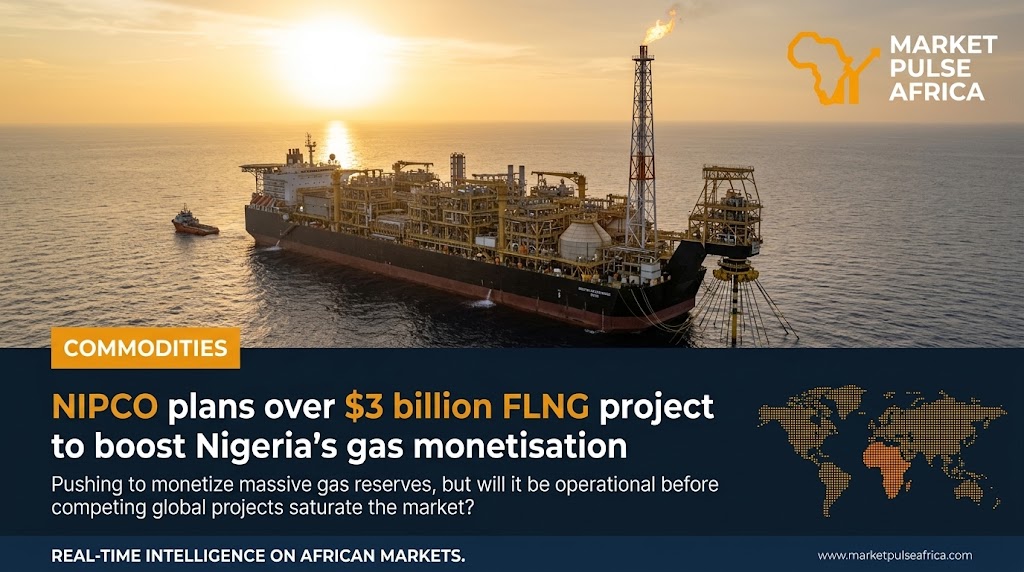
NIPCO plans over $3 billion FLNG project to boost Nigeria’s gas monetisation
NIPCO Group has unveiled plans for a $3bn+ Floating LNG project in Nigeria, targeting 3 million tonnes of annual capacity — here's what's known so far.
NIPCO Plans Over $3 Billion FLNG Project to Boost Nigeria's Gas Monetisation
NIPCO Group has unveiled plans for a Floating Liquefied Natural Gas (FLNG) facility valued at more than $3 billion, marking the diversified energy conglomerate's first move into Nigeria's LNG sector and adding another major private-sector bet on the country's long-discussed gas monetisation ambitions.
What Happened
NIPCO Gas Ltd. Managing Director Nagendra Verma announced the project on Thursday, September 24, 2026, at a press briefing in Abuja attended by NIPCO Group Chairman Chief Bestman Anekwe, Group Executive Director Alhaji Abdulkadir Aminu, and Company Secretary Paul Chukwuma Obi. Verma said the proposed FLNG facility would mark NIPCO's formal entry into the LNG sector and reinforce the group's long-term commitment to developing and monetising Nigeria's natural gas resources.
The project is targeted at an LNG production capacity of roughly three million tonnes per annum, comprising an offshore FLNG vessel alongside associated marine and export infrastructure. Verma said NIPCO has been evaluating the concept for six to nine months and is now conducting feasibility studies covering development concepts, technology solutions and financing structures, with the final investment requirement to be determined once engineering and commercial structuring are complete. Two potential locations are under review: the Escravos area of Delta State or the Akwa Ibom region, both chosen for their proximity to upstream feed gas, processing infrastructure and maritime transit routes.
Anekwe said the additional LNG capacity would support gas monetisation, industrial growth, energy security, foreign exchange generation and employment creation. He said the project would leverage NIPCO's existing relationships with the Nigerian National Petroleum Company Ltd. (NNPC Ltd.) and the Nigerian National Gas Midstream (NNGM) entity to secure feed gas, while the group forms strategic partnerships with international technology providers to advance the engineering side of the project.
Historical Context
NIPCO enters the LNG conversation from an established downstream base rather than as a newcomer to Nigeria's energy sector. The group operates a nationwide distribution network spanning Automotive Gas Oil, Premium Motor Spirit, LPG, propane, Piped Natural Gas and Compressed Natural Gas, supported by storage, logistics, transportation and retail infrastructure, and runs roughly 30 CNG stations across the country. NIPCO significantly expanded its downstream footprint in 2017 when its subsidiary, NIPCO Investments Limited, acquired a 60% majority stake in Mobil Oil Nigeria Plc from ExxonMobil in a deal valued at $301 million.
The FLNG announcement fits a pattern seen elsewhere in Nigeria's energy sector this year, where domestic and international players alike have pursued gas-focused projects designed to bypass the onshore pipeline bottlenecks and vandalism risk that have historically delayed Nigerian gas monetisation. Floating LNG technology, which processes and exports gas directly from offshore platforms, is specifically positioned to sidestep those infrastructure challenges.
Why It Matters for Africa
Nigeria holds some of Africa's largest proven natural gas reserves, yet has long struggled to convert that endowment into export revenue and domestic energy supply at the scale its reserves would suggest, largely due to underinvestment in gas infrastructure relative to oil. A new FLNG project of this scale — if it proceeds through feasibility to final investment decision — would add meaningful new liquefaction capacity alongside Nigeria's existing LNG facility at Bonny Island, diversifying the country's gas export infrastructure and reducing its historical over-reliance on a single liquefaction hub.
Beyond export volumes, the project speaks to a broader continental theme: African governments and private companies increasingly treating natural gas as a strategic bridge fuel, both for energy security and as a revenue diversification tool, at a moment when global LNG demand remains elevated. For Nigeria specifically, additional gas monetisation capacity supports the government's stated goals around foreign exchange generation and industrial development — themes that also run through the country's domestic gas expansion push and its broader effort to reduce reliance on imported refined petroleum products.
The project's success is far from guaranteed at this stage — it remains in feasibility, with final investment decision, capacity and timeline all contingent on regulatory approvals, technical assessments and financing outcomes still to be worked out.
Market Data & Key Numbers
Metric | Figure |
|---|---|
Estimated investment | More than $3 billion |
Target LNG capacity | ~3 million tonnes per annum |
Evaluation period to date | 6–9 months |
Proposed locations | Escravos (Delta State) or Akwa Ibom |
Announcement date | September 24, 2026 |
NIPCO's existing CNG station count | ~30 nationwide |
2017 Mobil Oil Nigeria acquisition | $301 million (60% stake) |
What Businesses and Investors Should Watch
Feasibility study outcomes, which will determine the project's final scope, cost and timeline.
Site selection between Escravos and Akwa Ibom, which will signal how NIPCO is weighing feed-gas access against export logistics.
Partnership announcements with international LNG technology providers and potential financing partners.
NNPC Ltd. and NNGM feed-gas agreements, given the project's stated reliance on those relationships for gas supply.
Final Investment Decision (FID) timing, the key milestone that would convert this from a stated ambition into a committed capital project.
Practical Guide: Key Takeaways
For Businesses
Nigerian oil-and-gas service providers, logistics firms and engineering contractors should note the project as a potential source of future contracting opportunities if it advances to construction.
Track regulatory signals from Nigerian authorities on gas infrastructure incentives, which could affect the project's ultimate economics and timeline.
For Investors
Treat this as an early-stage capital commitment announcement rather than a confirmed project — the $3 billion figure is an estimate pending feasibility and commercial structuring.
Watch for how NIPCO plans to finance a project of this scale relative to its existing downstream balance sheet, and whether external partners or lenders are brought in.
For General Readers
FLNG technology allows gas to be liquefied and exported directly from offshore platforms, avoiding the onshore pipeline infrastructure that has slowed similar projects in the past.
A project of this scale, if completed, could support job creation, foreign exchange earnings and energy security — but Nigeria has seen ambitious gas projects face delays before, so the feasibility and FID stages remain key hurdles.
How MarketPulse Africa Helps
Large-scale energy infrastructure announcements shape Nigeria's foreign exchange earnings, industrial development and energy security for years after they're first unveiled. MarketPulse Africa tracks major project announcements like NIPCO's proposed FLNG facility alongside Nigeria's broader gas and downstream petroleum sector, helping readers follow projects from initial announcement through feasibility, financing and — where they succeed — construction and operation.
Conclusion
NIPCO's proposed $3 billion FLNG project represents a significant statement of intent from one of Nigeria's established downstream players, aimed squarely at the country's persistent gas monetisation gap. With feasibility studies still underway and a final investment decision yet to come, the project's path from announcement to reality will depend on financing, regulatory support and site-specific technical outcomes still to be determined. Follow MarketPulse Africa for continued coverage as NIPCO advances the project through its early development stages.