
Paga CEO Tayo Oviosu says company processes $1.5 billion monthly
Paga CEO Tayo Oviosu says the fintech now processes $1.5 billion in monthly transactions, reflecting rapid growth.
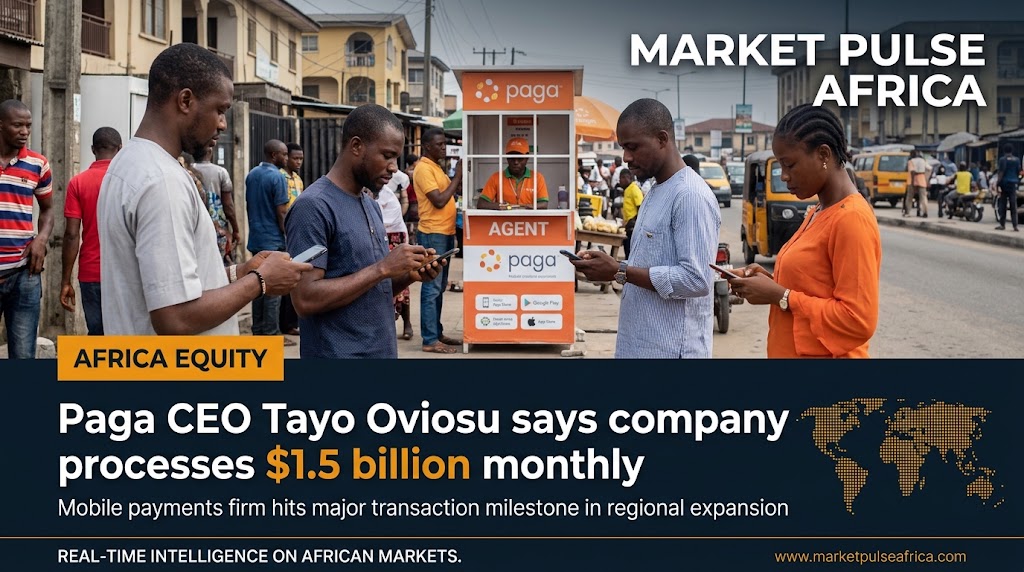
Paga CEO Tayo Oviosu Says Company Processes $1.5 Billion Monthly
Tayo Oviosu, founder and Group CEO of Nigerian fintech Paga, has disclosed that the company now processes about $1.5 billion in transaction volume every month, offering a fresh look at the scale one of Africa's oldest financial technology companies has reached 17 years after launching as a mobile money service.
What Oviosu Said
Oviosu made the disclosure during an interview with School of Hard Knocks, a program that returned to Nigeria to feature the Paga founder. He said the company now has more than 200 employees and is processing over $1.5 billion every month. On the company's valuation, Oviosu was less precise but still revealing: "It's hard to say in exact numbers, but my company is worth hundreds of millions of dollars." He also disclosed that the highest annual revenue the company had generated in a single year was about $60 million.
It's worth distinguishing between these figures. Transaction volume — the $1.5 billion monthly figure — reflects the total value moving through Paga's payments infrastructure, not the company's own revenue or profit. Revenue, which Oviosu put at a peak of $60 million in a single year, represents what Paga itself earns from facilitating that transaction volume, typically through fees.
The Numbers Behind the Headline
Oviosu's disclosure aligns with figures the company published earlier in 2026 when it announced a major leadership restructuring. According to that announcement, Paga's total transaction value processed grew 17-fold between 2021 and 2025, reaching $11 billion across 169 million transactions in 2025 alone — equivalent to more than $1.5 billion processed monthly, consistent with Oviosu's latest figure. Net revenues over the same 2021–2025 period grew fivefold, the company said, underscoring the scalability of its underlying business model. Separately, other reporting on the same restructuring put Paga's 2025 transaction value at ₦17.1 trillion ($12 billion) for the year, a 96% year-on-year jump.
Paga's growth trajectory has been building for years. In April 2024, the company disclosed it had processed N14 trillion in cumulative transactions across its first 15 years of operations, with about 80% of that volume recorded in just the preceding five years — a pattern consistent with the sharp acceleration reflected in the more recent figures. Earlier still, in January 2020, Oviosu had disclosed that Paga processed more than $2 billion in transactions during 2019 alone, supported by more than 14.4 million customers at the time, bringing the company's cumulative transaction value to about $6.6 billion since beginning commercial operations in 2012.
Historical and Business Context
Paga, founded by Oviosu in 2009, built its early business on a nationwide agent network that helped digitize cash transactions across Nigeria — a foundational model for Africa's broader mobile money and fintech sector. The company has since evolved into what it now describes as a full-stack financial services infrastructure provider, offering enterprise-facing infrastructure through "Paga Engine" alongside its consumer-facing app. Its enterprise client base has grown to more than 265 companies, including global names such as PayPal, Meta, Amazon, LemFi, Tencent, Pesa, and Verto, which build on Paga's payments infrastructure.
The company has also been expanding geographically and into new financial products. It launched U.S. banking services aimed at the African diaspora in September 2025 through a partnership with Regent Bank, and in January 2026 became PayPal's local partner in Nigeria — marking the global payments network's return to the Nigerian market after roughly two decades.
Alongside the growth disclosure, Paga has also undergone a significant leadership transition: Oviosu has moved from day-to-day oversight of Paga Nigeria into a Group CEO role, focused on geographic expansion into new African markets and building out the company's investments in stablecoins, cryptocurrency and AI-powered commerce. Ope Oyinloye has taken over as acting CEO of Paga Nigeria, pending Central Bank of Nigeria regulatory approval — marking the first time in the company's history that someone other than Oviosu has led its largest market.
Why It Matters for Africa
Paga's disclosed scale and growth trajectory carry several implications for Africa's broader fintech and investment landscape:
Fintech sector maturation. Paga's evolution from a consumer mobile money app into enterprise payments infrastructure — with global clients like PayPal and Meta building on its rails — illustrates a broader trend of African fintechs moving up the value chain from consumer products toward B2B infrastructure plays.
Investment and capital flows. With Paga reportedly planning a new funding round and having raised $45 million to date from investors including the Global Innovation Fund, Omidyar Network and Adlevo Capital, continued growth disclosures of this kind are relevant signals for venture and growth-equity investors evaluating African fintech opportunities.
Cross-border payments and diaspora finance. Paga's move into U.S. banking services for the African diaspora points to a growing theme across African fintechs: building financial rails that connect African markets to global commerce and remittance flows, a segment with significant unmet demand.
PayPal's re-entry into Nigeria. Paga's role as PayPal's local partner signals renewed interest from major global payments players in the Nigerian market, which could have broader implications for cross-border commerce and financial inclusion in the country.
Key Figures at a Glance
Metric | Figure |
|---|---|
Current monthly transaction volume | ~$1.5 billion |
2025 annual transaction value | $11–12 billion |
Transaction value growth, 2021–2025 | 17x |
Peak single-year revenue disclosed | ~$60 million |
Employees | 200+ |
Enterprise clients | 265+ (incl. PayPal, Meta, Amazon, Tencent) |
Capital raised to date | $45 million |
Company founded | 2009 |
What Investors Should Watch
Details of Paga's planned new funding round, including potential valuation benchmarks that could clarify the "hundreds of millions of dollars" figure Oviosu referenced.
Progress on Paga's stablecoin, crypto and AI-commerce investments under the company's "Act 2" strategic direction.
Regulatory approval progress for Ope Oyinloye's appointment as substantive CEO of Paga Nigeria.
Continued enterprise client growth on Paga Engine, as an indicator of the company's infrastructure-business trajectory beyond consumer payments.
Key Takeaways
For Businesses
Consider Paga Engine and similar African payments infrastructure providers when evaluating options for cross-border or domestic payment processing.
Monitor the growing presence of global payment players like PayPal re-entering African markets through local fintech partnerships.
For Investors
Distinguish clearly between transaction volume, revenue, and company valuation when assessing fintech growth disclosures — the three figures measure very different things.
Watch for Paga's upcoming funding round details as a benchmark for African fintech valuations.
For General Readers
Understand that a company processing billions in transactions doesn't necessarily mean it earns billions in revenue — the fee-based business model means actual company earnings are a much smaller fraction.
Follow how Nigerian fintechs are increasingly building bridges to global financial services, including U.S. banking access for diaspora communities.
How MarketPulse Africa Helps
For readers tracking Africa's fintech sector, MarketPulse Africa's Investment Signals coverage brings together funding developments, transaction volume disclosures, and strategic partnerships shaping the continent's financial technology landscape. MarketPulse Africa will continue following Paga's expansion and the broader African fintech investment story.
Conclusion
Tayo Oviosu's disclosure that Paga now processes $1.5 billion in transactions monthly underscores the scale one of Africa's earliest fintech companies has reached after 17 years of operation — and comes as the company pursues an ambitious "Act 2" strategy spanning new African markets, stablecoins, and cross-border diaspora banking. With a new funding round reportedly on the horizon, Paga's growth trajectory will be worth watching as a bellwether for African fintech investment more broadly. Follow MarketPulse Africa for continued coverage and real-time intelligence on African markets.