World Bank raises Sub-Saharan Africa's 2026 growth forecast to 4.3%
The World Bank now expects Sub-Saharan Africa to grow 4.3% in 2026, with upgrades for Nigeria, Angola, Ethiopia and Zambia. But inflation is rising and debt costs still bite.
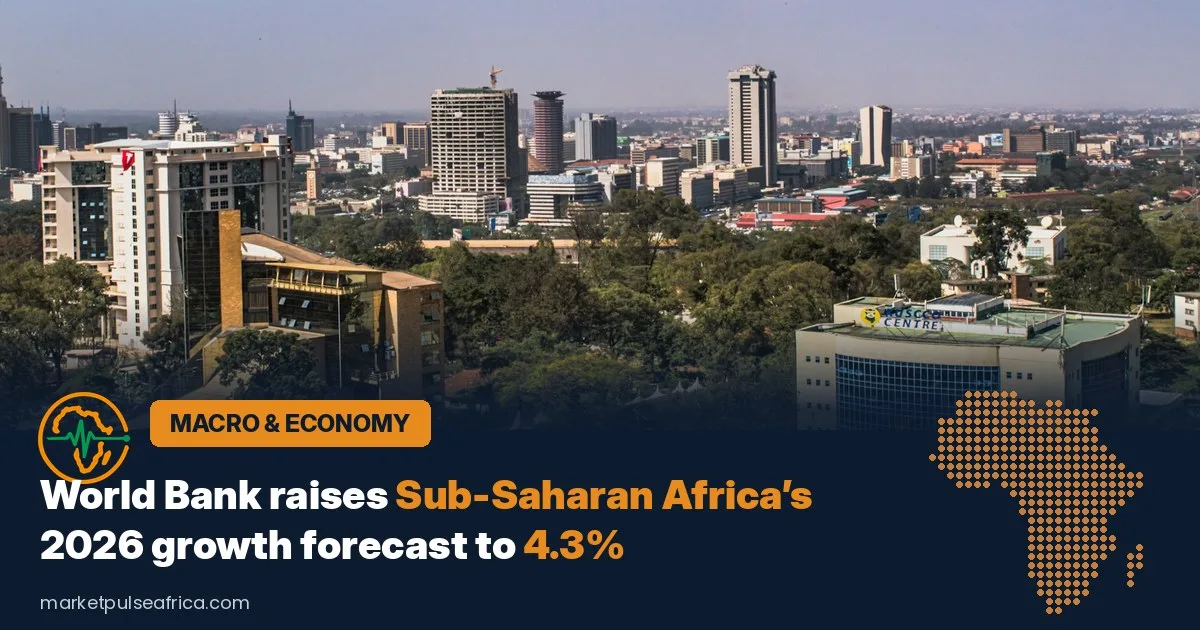
The World Bank has raised its 2026 growth forecast for Sub-Saharan Africa to 4.3%, up from 4.1% growth in 2025. The new projection, in its October Africa economic update released on 6 October, is about 0.3 percentage points higher than the Bank's April estimate, according to Daba Finance.
Nearly three-quarters of the region's economies were revised upwards, including Angola, Ethiopia, Nigeria and Zambia.
What is driving the upgrade
The Bank points to steadier macroeconomic management in several countries, stronger domestic demand and investment in energy and digital infrastructure. It also says the region has held up despite geopolitical tension, climate shocks and falling development aid. EWN also cited stronger domestic demand and improving economic conditions in several countries.
The forecast lines up with the IMF's own upgrades this month. The Fund raised Nigeria's 2026 growth forecast to 4.2%, as we reported on Tuesday.
Inflation is moving the wrong way
Price pressure is building even as growth improves. The World Bank expects median inflation in the region to rise to 5.5% in 2026, from 3.7% in 2025, as global prices for fuel, fertiliser and food climb. That squeezes household budgets and raises production costs for businesses, and it limits how far central banks can cut interest rates.
Debt still crowds out spending
Public debt has stabilised at around 57% of GDP, but debt service continues to eat into budgets that would otherwise go to health, education and infrastructure. The Bank lists tighter financing conditions among the main risks to the outlook, alongside escalating geopolitical tension, climate shocks such as El Niño and further cuts in aid.
Growth is not creating enough jobs
The Bank's central warning is that 4.3% growth is not fast enough to make a serious dent in extreme poverty or to absorb the region's growing workforce. Andrew Dabalen, the World Bank's chief economist for Africa, said the next challenge is turning growth into more jobs and better opportunities.
The AI section
This edition includes a chapter on artificial intelligence as a source of productivity and jobs. The Bank finds adoption is still at an early stage and concentrated in Kenya, Nigeria and South Africa. Weak connectivity limits how many workers can benefit, and AI use in the public sector is basic in most countries. Its advice is to invest first in the foundations: electricity, affordable internet and digital skills.
That fits the Bank's broader AI guidance this year, which urges developing economies to adapt existing tools to local needs rather than build their own frontier models. The IMF has made a related point on jobs: AI could affect up to 40% of jobs worldwide.
What it means for investors
For markets, the upgrade supports the case for African local-currency assets and equities in economies with improving fundamentals. Nigeria, Angola, Ethiopia and Zambia all moved up. The inflation forecast is the caveat. If food and fuel prices keep rising, central banks will have less room to ease, and real returns on local bonds may shrink.
The next checkpoints are the World Bank's spring update in April 2027 and inflation prints from the region's largest economies over the coming months.