
WORLD IN BRIEF: Maduro denies torture charges, German airport seizes 92 reptiles, South Africa phases out support for imported vehicle kits
Maduro denies new US torture charges, Cologne customs seize 92 reptiles from a traveler's luggage, and South Africa moves to end support for imported vehicle kit assembly.
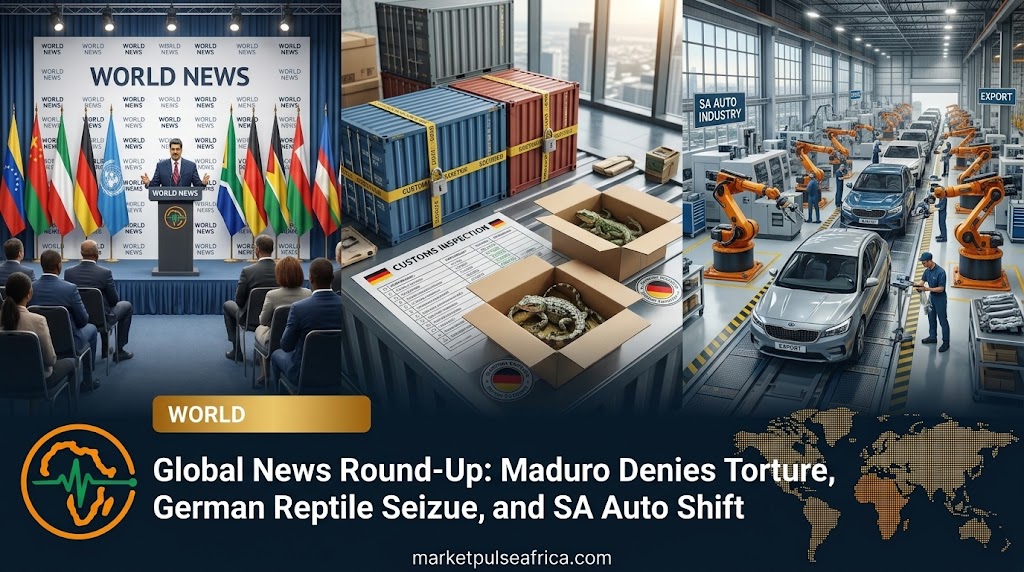
Ousted Venezuelan leader Nicolás Maduro has denied new US torture charges, filed on October 8, 2026. Customs officers at Cologne Bonn Airport seized 92 reptiles from a Mexican traveler's luggage. South Africa's trade minister said the government will phase out support for carmakers that assemble imported vehicle kits. Here is what we know about each story as of October 16, 2026.
Contents
- Maduro denies new US torture charges
- Cologne customs seize 92 reptiles
- South Africa phases out support for vehicle kit assembly
Maduro denies new US torture charges
US prosecutors added a conspiracy to torture count to the existing case against Nicolás Maduro and his wife, Cilia Flores, in a superseding indictment filed in federal court in Manhattan. The new charge alleges torture of nine people, including three US citizens, during detention in Venezuela. The indictment describes methods including electric shocks, waterboarding, rape, prolonged isolation and starvation, according to the Justice Department.
Maduro's lawyer, Barry Pollack, said in a statement that "President Maduro denies the charges in the new indictment and looks forward to his day in court." Flores's lawyers also said their client denies the allegations. The couple has pleaded not guilty to the original drug trafficking and weapons charges but has not yet entered pleas to the torture count. Each faces a mandatory minimum of 50 years in prison if convicted of all the charges. Both have argued that they have immunity as head of state and first lady, and have asked for the charges to be dismissed.
The couple was captured in January during a US military operation in Caracas and has been held in Brooklyn since. Nothing has been proven in court, and the new charges are allegations.
Cologne customs seize 92 reptiles
German customs officers at Cologne Bonn Airport found 37 venomous snakes and 55 lizards hidden in shampoo bottles, cream containers and socks in the luggage of a 45-year-old Mexican traveler. The traveler, a firefighter, had arrived from Mexico City via Istanbul. Customs officials said he behaved in a "nervous" manner, and a drug test later indicated he had taken cocaine. The stop happened last month, and the details were announced on October 15.
About 30 of the animals died during or after the journey, according to customs. The survivors were taken to a snake farm in central Germany. The traveler told officials he had brought the animals as a favour for a Brazilian acquaintance. German authorities denied him entry and sent him back to Istanbul the next day. Customs said it recorded more than 1,300 wildlife seizures nationwide last year, involving more than 56,600 protected animals and plants or products made from them.
South Africa phases out support for vehicle kit assembly
Trade Minister Parks Tau said on October 15 that South Africa will phase out policy support for semi-knocked-down (SKD) assembly, the practice of building vehicles from near-complete imported kits. New SKD facilities will not receive support, and existing operations will lose support as they wind down. Tau said the government would also tighten the legal definition of complete knock-down (CKD) manufacturing, where vehicles are built from locally sourced parts. The change does not apply to medium and heavy commercial vehicles.
The move is part of a review of the Automotive Production and Development Programme, the sector's incentive framework, carried out with the industry body Naamsa, the component makers' association Naacam and organized labour. Its aim is to raise local content to 60 percent by 2035, from an average of about 38 percent today. The government will also examine whether light commercial "ladder-frame" vehicles, including pickup trucks, need extra support. No phase-out date has been announced, and the government has not said how many jobs or vehicles are affected.
Toyota South Africa's chief executive, Andrew Kirby, had argued that the country's automotive sector had moved beyond kit assembly and that it could undermine larger investments in full-scale production. For investors, the policy signals a shift toward deeper manufacturing, which could affect assembly plants and the component suppliers that serve them.